
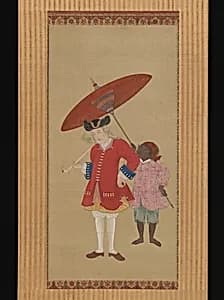
Dutchman with a Servant
early 19th century
Medium
Hanging scroll; ink and color on silk, negoro lacquer roller knobs
Dimensions
Image: 19 3/4 x 9 7/8 in. (50.2 x 25.1 cm)
Classification
Paintings
Culture & Period
Japan · Edo period (1615–1868)
Department
Asian Art
Museum
Metropolitan Museum of Art, New York, NY
Credit
Gift of Florence and Herbert Irving, 2015
Accession Number
2015.500.9.45
Rights
Public Domain
Tags
Art Historical Context
In the early 19th century, Japan's Edo period (1615–8), artist Kawahara Keiga captured fascinating moment of cultural encounter in *Dutchman with a Servant This hanging scroll, rendered in vibrant ink and color on silk depicts a European trader—likely a Dutchman from the enclave of Dejima in Nagasaki— by a Japanese servant. Keiga, a master of the Nagasaki school, in portraying foreigners, blending meticulous Japanese brushwork with subtle Western influences amid Japan's sakoku isolation policy, which restricted foreign trade to this single port. The painting's intimate scale (19 3/4 x 9 7/8 in.) and luxurious details, such as the negoro lacquer roller knobs, highlight its status as a collector's item. Tags evoke the scene: the Dutchman leisurely smoking a pipe, shaded by a parasol held by his attendant, symbolizing the exotic allure of Westerners in a rigidly hierarchical society. Such works offered Japanese viewers rare glimpses into global exchanges, underscoring art's role in bridging worlds. Today, housed in the Metropolitan Museum of Art's Asian Art department (gift of Florence and Herbert Irving, 2015), this scroll invites us to ponder the tensions and curiosities of early globalization.