
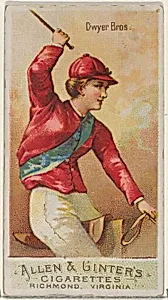
Dwyer Brothers, from the Racing Colors of the World series (N22a) for Allen & Ginter Cigarettes
1888
Medium
Commercial color lithograph
Dimensions
Sheet: 2 3/4 x 1 1/2 in. (7 x 3.8 cm)
Classification
Prints|Ephemera
Department
Drawings and Prints
Museum
Metropolitan Museum of Art, New York, NY
Credit
The Jefferson R. Burdick Collection, Gift of Jefferson R. Burdick
Accession Number
63.350.201.22.10
Rights
Public Domain
Tags
Art Historical Context
Step into the vibrant world of 19th American ephemera with *Dwyer Brothers, from Racing Colors of the World (N22a)*, a diminutive commercial color lithograph produced by Allen & Ginter 1888. Measuring just 2¾ x 1½ inches, this tiny card was one of many inserted into cigarette packs, transforming everyday tobacco products into collectible treasures. Allen & Ginter, pioneering tobacco magnates, issued these cards to captivate smokers and racing enthusiasts, showcasing the colorful silk jockey uniforms—or "racing colors"—of famous stables worldwide, including the prominent Dweller Brothers team. The card's tags highlight intriguing profiles of women jockeys, a nod to the era's evolving equestrian culture where horse racing gripped the public imagination amid America's Gilded Age boom. Though women were rare in professional racing, such depictions fantasy and fandom, blending sport, gender intrigue, and commercial savvy. Crafted via chromolithography—a breakthrough technique for mass-producing vivid, multi-layered colors on paper—this print exemplifies the artistry of advertising, packing bold hues and precise details into postcard-sized ephemera. Today, housed in the Metropolitan Museum of Art's Drawings and Prints department as part of the Jefferson R. Burdick Collection, it reminds us how everyday objects captured the thrill of the turf, bridging art, commerce, and leisure in late Victorian America.
About the Artist
Allen & Ginter
Allen & Ginter, the pioneering American tobacco firm based in Richmond, Virginia, emerged around 1880 from the partnership of John F. Allen and Lewis Ginter, evolving from Allen's earlier John F. Allen & Company. Allen retired in 1882, succeeded by John Pope, yet the brand endured under Ginter's leadership, employing over 1,100 workers—mostly women—for hand-rolled cigarettes by 1886. Ginter, a Dut...