
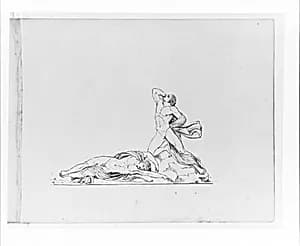
Dying Warriors (from Sketchbook)
ca. 1860
Medium
Graphite on paper
Dimensions
8 1/16 × 11 in. (20.5 × 27.9 cm)
Classification
Drawing
Culture
American
Department
The American Wing
Museum
Metropolitan Museum of Art, New York, NY
Credit
Gift of Edward R. Grove, 1985
Accession Number
1985.351.11 recto
Rights
Public Domain
Tags
Art Historical Context
In the American Wing of the Metropolitan Museum Art, John Quincy Adams's *Dying Warriors (from Sketchbook)* (ca. 1860) offers a poignant glimpse into the preparatory work of one of 19th-century America's leading sculptors. Rendered in graphite on paper, this modest 8 1/16 × 11 in. sheet captures dynamic studies of fallen male warriors, their nude forms twisted in agony and defeat. Ward, celebrated for monumental public sculptures like the *Indian Hunter* and Civil War memorials, often began with such sketches to refine anatomy and emotion before committing to marble or bronze. Created around the eve of the Civil War, the drawing reflects neoclassical ideals of heroic masculinity and mortality, drawing from ancient Greek and Roman precedents while asserting American artistic ambition. The repeated motifs of male nudes in death underscore Ward's mastery of the figure, emphasizing musculature, torsion, and pathos—essential for his realistic, narrative-driven style that bridged Romanticism and emerging modernism. This intimate sketchbook page, a gift from Edward R. Grove in 1985, reveals the artist's process: quick, expressive lines building volume and drama on humble paper. It invites visitors to appreciate how raw ideas blossomed into enduring public monuments, humanizing the heroism of battle.
About the Artist
John Quincy Adams Ward · 1830–1910
John Quincy Adams Ward (1830–1910) was born in Urbana, Ohio, the fourth of eight children, and displayed an early aptitude for three-dimensional form, modeling figures in clay from childhood. In 1849 he moved to Brooklyn, New York, to apprentice under the sculptor Henry Kirke Brown, with whom he worked for seven years. Brown's emphasis on American subjects and his conviction that sculpture should ...