
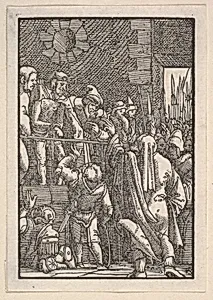
Ecce Homo, from The Fall and Salvation of Mankind Through the Life and Passion of Christ
ca. 1513
Medium
Woodcut
Dimensions
Sheet: 3 1/8 × 2 3/16 in. (7.9 × 5.5 cm)
Classification
Prints
Department
Drawings and Prints
Museum
Metropolitan Museum of Art, New York, NY
Credit
Rogers Fund, 1920
Accession Number
20.11.31
Rights
Public Domain
Tags
Art Historical Context
Albrecht Altdorfer’s *Ecce Homo* forms part of his early-sixteenth-century series *The Fall and Salvation of Mankind Through the Life and Passion of Christ*. Created around 1513, the small woodcut captures the dramatic moment when Pontius Pilate presents Christ to the crowd, a pivotal scene in the Passion narrative. Altdorfer, a leading figure of the Danube School, worked during the Northern Renaissance, when printmaking helped spread religious stories across Europe. As a woodcut, the work exploits the medium’s bold contrasts and crisp lines to convey emotion within a compact format measuring just over three by two inches. The technique allowed multiple impressions, making devotional images accessible beyond church walls and supporting the era’s growing interest in personal piety. Housed in the Metropolitan Museum of Art’s collection of Drawings and Prints, this intimate sheet invites close viewing. Its presence among other Passion scenes underscores Altdorfer’s skill at distilling complex theological ideas into vivid, portable art that continues to engage viewers today.
About the Artist
Albrecht Altdorfer · 1475–1538
Albrecht Altdorfer (c. 1480–1538) was a German painter, printmaker, and draftsman who stands as one of the founders of landscape painting as an independent genre. Born in Regensburg or nearby Altdorf, he learned art from his father Ulrich, a painter and miniaturist. Altdorfer spent most of his life in Regensburg, becoming a citizen in 1505 and later serving as the city's official architect and a m...