
Ecce Homo
1613
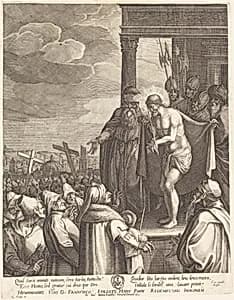
Medium
engraving on laid paper
Dimensions
plate: 34.5 × 24.9 cm (13 9/16 × 9 13/16 in.) sheet: 25 × 37.6 cm (9 13/16 × 14 13/16 in.)
Classification
Department
CG-E
Museum
National Gallery of Art, Washington, D.C.
Credit
R.L. Baumfeld Collection
Accession Number
1969.15.296
Rights
Public Domain
Art Historical Context
Behold the poignant *Ecce Homo* (1613), an engraving by the masterful French printmaker Jacques Callot. This evocative work depicts the biblical moment when Pontius Pilate presents the thorn-crowned Christ to the jeering crowd, a dramatic scene central to Christian iconography. Created early in Callot's career during his time influenced by Italian Mannerism, it showcases his emerging genius for intricate, emotionally charged compositions that blend religious devotion with theatrical intensity. Rendered in engraving on laid paper—a technique involving precise incisions into a metal plate to produce rich, detailed impressions—the print measures a substantial plate size of 34.5 × 24.9 cm. Callot's virtuosic line work captures the tension of figures in dynamic poses, from the mocking mob to Christ's dignified suffering, demonstrating the medium's power for mass dissemination of sacred imagery during the Counter-Reformation era. Housed in the National Gallery of Art's R.L. Baumfeld Collection, this piece highlights Callot's pivotal role in elevating printmaking to fine art. Visitors will appreciate how its fine details reward close viewing, inviting reflection on faith, humanity, and artistic innovation in the early Baroque period.
About the Artist
Jacques Callot · 1592–1635
Jacques Callot (1592–1635) was a French printmaker and draftsman from the Duchy of Lorraine, widely regarded as one of the first great artists to practice the graphic arts exclusively. His more than 1,400 etchings chronicled the breadth of 17th-century life, from Medici court festivities to the brutal realities of warfare. Callot revolutionized etching through technical innovations including the é...