
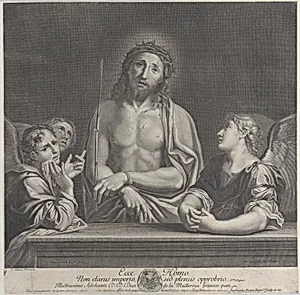
Ecce Homo with three angels
1652–1721
Medium
Engraving
Dimensions
Sheet (Trimmed): 16 1/8 × 16 1/4 in. (40.9 × 41.2 cm)
Classification
Prints
Department
Drawings and Prints
Museum
Metropolitan Museum of Art, New York, NY
Credit
The Elisha Whittelsey Collection, The Elisha Whittelsey Fund, 1953
Accession Number
53.600.4169
Rights
Public Domain
Art Historical Context
This engraving, titled *ce Homo with three angels captures the poignant biblical when Pontius Pilate presents Christ to the crowd with the Latin words “Behold the man.” Created as a reproductive print after a composition by the Bolognese Baroque painter Francesco Albani, the work was engraved by Etienne Picart between the mid-seventeenth and early eighteenth centuries. Albani’s original paintings often blended tender religious subjects with graceful, classical figures, and this print preserves that elegant sensibility for a wider audience. As an engraving, medium allowed intricate details—such as the delicate modeling of Christ’s form and the ethereal presence of the three angels—to be disseminated across Europe. Printmaking played a vital role in the Baroque period, transforming paintings from private chapels or collections into accessible devotional images that could inspire faith and admiration in homes and churches far from Italy. Housed in the Metropolitan Museum of Art’s Department of Drawings and Prints, this sheet (measuring roughly 16 by 16 inches) exemplifies how reproductive engravings extended the reach of celebrated masters like Albani, ensuring their visions of compassion and divinity continued to resonate with viewers long after the original canvas was completed.
About the Artist
Francesco Albani|Etienne Picart · 1578–1660
Collaborated with Annibale Carracci and Domenichino on many decorative schemes, including some in the Palazzo Farnese in Rome. He also painted altarpieces, idyllic landscapes, and allegorical paintings. Comment on works: Religious; Mythology