
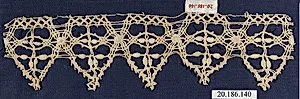
Edging
Unknown Artist
17th century
Medium
Bobbin lace
Dimensions
L. 7 1/2 x W. 2 inches 19.1 x 5.1 cm
Classification
Textiles-Laces
Culture
Italian, Genoa
Department
European Sculpture and Decorative Arts
Museum
Metropolitan Museum of Art, New York, NY
Credit
Rogers Fund, 1920
Accession Number
20.186.140
Rights
Public Domain
Art Historical Context
This exquisite bobbin lace edging, in 17th-century, Italy, exemplifies the city's renowned mastery of lace-making during the Baroque era. Measuring just 7½ by 2 inches (19.1 x 5.1 cm), this narrow trim was likely designed to adorn the edges of garments, linens, or ecclesiastical vestments, adding a touch of opulent refinement to everyday luxury. Bobbin lace, a technique using multiple bobbins to twist and braid fine threads into intricate, openwork patterns, reached new heights of complexity in Genoa. Unlike needle lace, bobbin methods allowed for precise, geometric motifs that showcased the lacemaker's skill and patience—often requiring dozens of bobbins pinned to a cushion. Genoese laces were prized across Europe for their durability and elegance, symbolizing wealth and status among the elite. Acquired through the Rogers Fund in 1920 and housed in The Metropolitan Museum of Art's Department of European Sculpture and Decorative Arts, this anonymous work highlights Italy's pivotal role in textile innovation, inviting us to appreciate the unseen artistry in historical finery.