
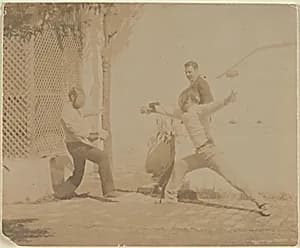
Edmund Quinn Fencing
1880s
Medium
Gelatin silver print
Dimensions
Image: 9.1 x 11 cm (3 9/16 x 4 5/16 in.)
Classification
Photographs
Department
Photographs
Museum
Metropolitan Museum of Art, New York, NY
Credit
Gift of Charles Bregler, 1944
Accession Number
44.75.9
Rights
Public Domain
Tags
Art Historical Context
In the late 1880s, American realist painter Thomas Eakins captured dynamic motion of fencer Edmund Quinn in this intimate gelatin silver print, measuring just 9.1 x 11 cm. Eakins, renowned for his meticulous studies of the human body in action, turned to photography as a tool to dissect anatomy and movement with scientific precision. This image, likely made in his Philadelphia studio, freezes Quinn mid-lunge, showcasing the grace and intensity of fencing—a sport gaining popularity in America during the Gilded Age. Gelatin silver prints, introduced in the 1870s, revolutionized photography with their sharp detail and tonal range, allowing Eakins to produce reference images for his paintings. Unlike posed portraits, Eakins' sports photographs emphasized naturalism and athletic vigor, reflecting his belief in art's alliance with science. Quinn, possibly a student or local athlete, embodies the era's fascination with physical prowess amid industrialization. Today, housed in the Metropolitan Museum of Art thanks to a 1944 gift from Eakins devotee Charles Bregler, this print highlights the artist's pioneering role in bridging painting and photography. It invites visitors to appreciate how a fleeting moment of sport became an enduring study in form and energy.
About the Artist
Thomas Eakins · 1844–1916
Thomas Eakins (1844-1916) was an American painter, photographer, and educator who carried 19th-century American Realism to its highest achievement. Based in Philadelphia throughout his life, he created uncompromising portraits and genre scenes that depicted American life with a scientific precision and psychological depth unprecedented in his time. Born into an educated Philadelphia family, Eakin...