
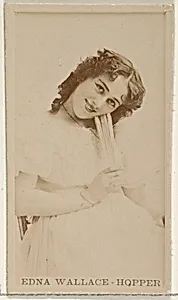
Edna Wallace-Hopper, from the Actors and Actresses series (N45, Type 8) for Virginia Brights Cigarettes
ca. 1888
Medium
Albumen photograph
Dimensions
Sheet: 2 5/8 x 1 1/2 in. (6.6 x 3.8 cm)
Classification
Photographs|Ephemera
Department
Drawings and Prints
Museum
Metropolitan Museum of Art, New York, NY
Credit
The Jefferson R. Burdick Collection, Gift of Jefferson R. Burdick
Accession Number
63.350.203.45.1521
Rights
Public Domain
Tags
Art Historical Context
This charming albumen photograph captures Edna Wallace-Hopper, a celebrated actress of the late 19th century, as part of Allen & Ginter's Actors and Actresses series (45, Type 8). Produced around 1888 to promote Virginia Brights Cigarettes, the diminutive card—measuring just 2⅝ × 1½ inches—exemplifies the era's trade cards, small printed inserts tucked into cigarette packs to entice collectors. Allen & Ginter, pioneering tobacco entrepreneurs, revolutionized marketing with these vibrant series, blending photography and lithography to showcase celebrities. The albumen process, a hallmark of 19th-century photography, yields rich tones and fine detail on paper coated with egg whites, making these cards both affordable and visually striking. This piece reflects the Gilded Age's theater mania, where stars like Wallace-Hopper embodied glamour and escapism amid rapid industrialization. Women performers, often trailblazers, gained fame through such ephemera, bridging popular culture and commerce. Housed in the Metropolitan Museum of Art's Jefferson R. Burdick Collection—a treasure trove of American print ephemera gifted in 1948—this card highlights how everyday objects preserved cultural icons, offering a window into Victorian-era celebrity worship and the dawn of mass-market collecting.
About the Artist
Allen & Ginter
Allen & Ginter, the pioneering American tobacco firm based in Richmond, Virginia, emerged around 1880 from the partnership of John F. Allen and Lewis Ginter, evolving from Allen's earlier John F. Allen & Company. Allen retired in 1882, succeeded by John Pope, yet the brand endured under Ginter's leadership, employing over 1,100 workers—mostly women—for hand-rolled cigarettes by 1886. Ginter, a Dut...