
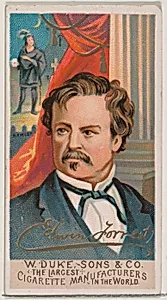
Edwin Forrest, from the series Great Americans (N76) for Duke brand cigarettes
Medium
Commercial color lithograph
Dimensions
Sheet: 2 3/4 × 1 1/2 in. (7 × 3.8 cm)
Classification
Prints|Ephemera
Department
Drawings and Prints
Museum
Metropolitan Museum of Art, New York, NY
Credit
The Jefferson R. Burdick Collection, Gift of Jefferson R. Burdick
Accession Number
63.350.204.76.13
Rights
Public Domain
Tags
Art Historical Context
Step into the vibrant world of 19th-century American advertising with this petite commercial color lithograph,Edwin Forrest, from series Great Americans (N)*, produced by W. Duke Sons & Co. in 1888. Measuring just 2 3/4 × 1 1/2 inches, this card honors Edwin Forrest (1806–1872), the pioneering American actor hailed as the nation's first great tragedian. Known for his powerful portrayals in Shakespearean roles like Othello and King Lear, Forrest the rising cultural confidence of a young America, blending raw emotion with patriotic fervor. Issued as part of Duke's "Great Americans" series (cataloged as N76), these cards were tucked into cigarette packs to entice collectors and boost sales amid fierce tobacco competition. Chromolithography, the era's breakthrough in mass-produced color printing, allowed for vivid, eye-catching portraits that made everyday ephemera feel like treasures. Housed in the Metropolitan Museum of Art's Jefferson R. Burdick Collection, this piece exemplifies how commerce intertwined with celebrity, preserving snapshots of national heroes for ordinary folks. Today, it whispers of Gilded Age ingenuity—where a simple trade card bridged theater glamour and consumer culture, reminding us how even small prints captured big dreams.
About the Artist
W. Duke, Sons & Co. · 1870–1920
**W. Duke, Sons & Co.: Pioneers of Chromolithographic Trade Card Art** W. Duke, Sons & Co., an American tobacco manufacturer, emerged from the entrepreneurial vision of Washington Duke (1820–1905) and his sons in Durham, North Carolina. After the Civil War, Washington abandoned farming in 1874 to join his eldest son, Brodie L. Duke, in the burgeoning tobacco trade, establishing a factory that for...