
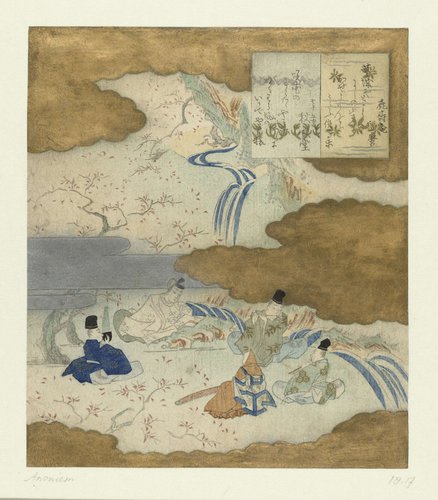
Een muziekfeestje
1836
Medium
nishikie, with metallic pigments and (hand-painted) gold lacquer
Dimensions
181; 201
Rights
Public Domain
About this artwork
collector's mark, passe-partout, bottom left, printed: JABdH with a rooster.
Art Historical Context
**Een muziekfeestjeA Music Party), 1836** This charming anonymous woodblock print, titled *Een muziekfeestje—Dutch for "A Music"—captures a lively gathering centered on music, evoking the joys of social harmony in 19th-century Japan. Created in 1836 during the late Edo period, it exemplifies *nishikie*, or "brocade pictures a prestigious style of ukiyo-emaking known for its opulent, multicolored designs that mimicked the sheen of fine textiles. Measuring just 201mm high by 181mm wide, its intimate scale made it perfect for personal collections, offering a window into everyday pleasures amid Japan's vibrant urban culture. The artwork's medium shines through its use of metallic pigments and hand-painted gold lacquer, techniques that elevated *nishikie* beyond ordinary prints. These luxurious embellishments—gold flecks and shimmering inks—added depth and realism, reflecting the era's fascination with *ukiyo* (the "floating world" of fleeting amusements). Artisans meticulously applied colors and metals post-printing, creating a tactile, jewel-like quality that symbolized refinement and prosperity. A collector's mark in the bottom left—"JABdH with a rooster"—hints at its esteemed provenance, likely from a European collector bridging Eastern and Western tastes. As a snapshot of musical revelry, this piece underscores music's cultural role in fostering community, inviting visitors to imagine the melodies echoing from its delicate surface.
About the Artist
anonymous
In the vast tapestry of art history, "Anonymous" stands not as a singular individual but as a collective designation for countless unidentified creators whose works have endured across millennia. These artists, spanning prehistoric cave painters to medieval illuminators and folk craftsmen, produced the foundational layers of human visual culture. Prior to the Renaissance, when individual fame emer...