
Een reuzenradijs
1626
Medium
Oil on panel
Dimensions
87.5; 53.5
Rights
Public Domain
About this artwork
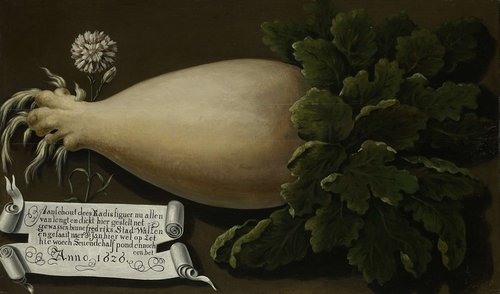
Een reuzenradijs, met een gewicht van meer dan zeven en een half pond. Links een inscriptie op een blad papier en een anjer.
Art Historical Context
Step into the curious world of 17th Dutch still life with *Een reuzenradijs* (A Giant Radish), an anonymous-on-panel painting from 1626 now housed in the Rijks. This modest yet mesmerizing work (53.5 × 87.5 cm) captures a colossal radish tipping the scales at over seven and a half pounds—a true marvel of nature. To the left, a sheet of paper bears an inscription, likely detailing the vegetable's extraordinary weight or origin, accompanied by a delicate carnation adding a touch of floral elegance. Created during the Dutch Golden Age this piece reflects the era's obsession with natural wonders and bountiful harvests, symbols of prosperity following the Netherlands' hard-won independence from Spanish rule. Still lifes like this celebrated the wonders of the natural world, often showcasing oversized produce from gardens or markets to evoke awe and abundance. Oil on panel allowed for the fine detail needed to render the radish's textured skin and earthy heft with hyper-realistic precision, a hallmark of early Northern European trompe-l'œil techniques. Though anonymous, the artist masterfully balances humility and spectacle, inviting viewers to ponder nature's surprises. Imagine the pride of the grower whose radish achieved such fame— a snapshot of everyday wonder turned artistic treasure.
About the Artist
anonymous
In the vast tapestry of art history, "Anonymous" stands not as a singular individual but as a collective designation for countless unidentified creators whose works have endured across millennia. These artists, spanning prehistoric cave painters to medieval illuminators and folk craftsmen, produced the foundational layers of human visual culture. Prior to the Renaissance, when individual fame emer...