
682/?
1875 - 1876
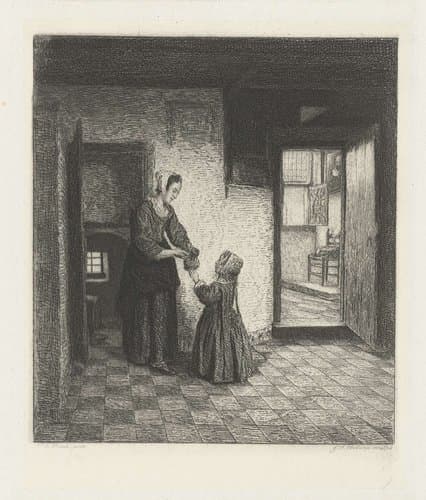
Medium
etching
Dimensions
140; 180
Rights
Public Domain
About this artwork
verzamelaarsmerk, verso, gestempeld: Lugt 2228
Art Historical Context
**Johannes Arnoldus Boland "682/?" (1875-1876)** This intimate etching by Dutch artist Johannes Arnoldus Bol, measuring just 180mm by 140mm, dates to the mid-1870s, a period when Boland was honing his skills as a printmaker after studying at The Hague Academy. Boland (1857-1932), part of the vibrant Dutch etching revival, captured the nuanced light and textures of his native landscapes and everyday scenes with remarkable precision. Though the specific subject of this work remains unidentified—hinted by the enigmatic title "682/?"—its compact scale suggests it was designed for collectors' albums, a popular format for 19th-century prints. Etching, Boland's chosen medium, involves incising lines into a metal plate with acid, allowing for delicate lines and tonal depth that rivaled painting. This technique flourished in the Netherlands during the 1870s, echoing Rembrandt's legacy while embracing modern realism. The print's verso bears Lugt 2228, the stamped collector's mark of the Rijksmuseum's Printroom in Amsterdam, underscoring its institutional significance and preserved provenance. A gem for print enthusiasts, this work highlights Boland's contribution to Dutch graphic arts, bridging Romantic traditions with emerging Impressionist influences. Visitors can appreciate how such modest etchings fueled the era's collector culture, making fine art accessible beyond canvas.
About the Artist
Johannes Arnoldus Boland · 1838–1922
Johannes Arnoldus Boland (1838–1922) was a Dutch etcher and engraver who played a significant role in the 19th-century etching revival in the Netherlands while serving as a restorer at the Rijksmuseum in Amsterdam for over three decades. Born on December 19, 1838, in Geesteren, a small town in the eastern Netherlands, Boland dedicated his career to both preserving and creating art, embodying the d...