
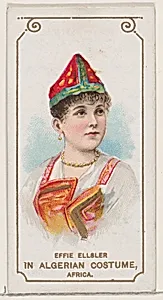
Effie Ellsler in Algerian Costume of Africa, from the set Actors and Actresses, First Series (N70) for Duke brand cigarettes
Medium
Commercial color lithograph
Dimensions
Sheet: 2 3/4 x 1 1/2 in. (7 x 3.8 cm)
Classification
Prints|Ephemera
Department
Drawings and Prints
Museum
Metropolitan Museum of Art, New York, NY
Credit
The Jefferson R. Burdick Collection, Gift of Jefferson R. Burdick
Accession Number
63.350.204.70.40
Rights
Public Domain
Tags
Art Historical Context
Step into the vibrant world of 19th-century advertising with *Effie Ellsler in Costume of Africa*, a commercial color lithograph from 1888–89 *Actors and Actresses, Series (N70)* for Duke brand cigarettes. Produced W. Duke, Sons & Co. in collaboration with Knapp & Company, this tiny card (just 2 3/4 x 1 1/2 inches) captures actress Effie Ells in an exotic "Algerian" outfit, blending theater glamour with Orientalist fantasy popular in Victorian-era entertainment. These cards were ingenious marketing tools, tucked into cigarette packs to entice collectors and promote tobacco sales amid fierce competition. Color lithography allowed for affordable, eye-catching mass production, making high-quality images accessible to everyday enthusiasts. The series celebrated female stars, reflecting the rising fame of actresses in American culture while evoking distant locales through costume drama. Today, housed in the Metropolitan Museum of Art's Jefferson R. Burdick Collection, this ephemera highlights how everyday objects preserved celebrity and cultural trends. A delightful glimpse into Gilded Age collecting mania!
About the Artist
W. Duke, Sons & Co.|Knapp & Company · 1870–1920
**W. Duke, Sons & Co.: Pioneers of Chromolithographic Trade Card Art** W. Duke, Sons & Co., an American tobacco manufacturer, emerged from the entrepreneurial vision of Washington Duke (1820–1905) and his sons in Durham, North Carolina. After the Civil War, Washington abandoned farming in 1874 to join his eldest son, Brodie L. Duke, in the burgeoning tobacco trade, establishing a factory that for...