
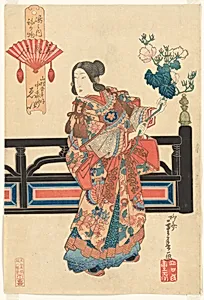
「嶋之内ねり物 華陽夫人 山村吾斗好 中森軒 ゑい」|“Ei of the Nakamoriken Brothel, who was a favorite of Yamamura Goto, as Lady Huayang (Kayō Fujin Yamamura Goto gonomi Nakamoriken Ei),” from the series Costume Parade of the Shimanouchi District in Osaka (Naniwa Shimanouchi nerimono)
Medium
Right sheet of a diptych of woodblock prints (nishiki-e); ink and color on paper; vertical ōban
Dimensions
Image: 14 3/4 × 10 in. (37.5 × 25.4 cm)
Classification
Prints
Culture & Period
Japan · Edo period (1615–1868)
Department
Asian Art
Museum
Metropolitan Museum of Art, New York, NY
Credit
Purchase, Friends of Asian Art Gifts, 2020
Accession Number
2020.305
Rights
Public Domain
Art Historical Context
Step into the vibrant world of-period Osaka with this exquisite woodblock print by Ryūsai Shigeu (active 1800s), a master of the Kamigata-e style from Japan's thriving print culture. Titled “Ei of the Nakamor Brothel, who was favorite of Yamamura Goto as Lady Huayang this is the right sheet of a diych from the series *Costume Parade of the Shouchi District in Osaka (Naniwa Shimani nerimono)*, created in 1836 Rendered in lush *nishiki-e* (brocade pictures)—multi-color woodblock printing on paper—it captures the glamour of Shimanouchi, Osaka's famed pleasure quarter, during annual parades where courtesans donned elaborate costumes inspired by literature and theater. The image portrays Ei, a popular courtesan from the Nakamoriken brothel and favorite of the merchant Yamamura Goto, dressed as Lady Huayang, a seductive figure from the classic Chinese novel *Romance of the Three Kingdoms*. These *nerimono* processions were festive spectacles blending fashion, performance, and celebrity culture, immortalizing the "floating world" (*ukiyo*) of entertainment districts. Ryūsai's keen eye for bijin-ga (beautiful women) highlights Ei's poised elegance, flowing robes, and intricate hair ornaments, reflecting Osaka's distinct, more realistic style compared to Tokyo's ukiyo-e. As a vertical *ōban* print (37.5 × 25.4 cm), its vivid inks and precise carving showcase the technical brilliance of *nishiki-e*, using up to 20 color blocks for jewel-like tones. Acquired by the Metropolitan Museum of Art in 2020, this piece offers a window into 19th-century Japan's urban pleasures and the artistry that celebrated them.