
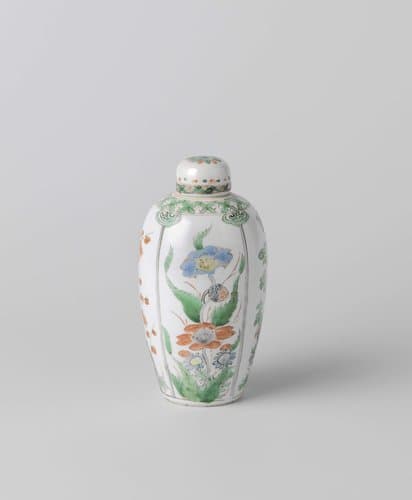
Eivormige dekselpot met bloeiende planten in vakken
ca. 1700 - ca. 1724
Medium
turning
Dimensions
7.2; 14.2
Rights
Public Domain
Art Historical Context
**Eivormige dekselpot met bloei planten in vakken** *Anonymous, ca. 1700–1724, turning, h 14.2 cm × d 7.2 cm* This delicate egg-shaped lidded pot the exquisite craftsmanship of early 18th-century European decorative arts. Crafted anonymously using the turning technique—where a lathe spins material like wood or ivory to create precise, symmetrical forms—the vessel features blooming plants arranged in neat compartments around its body. At just 14.2 cm tall, its compact size and intricate detailing highlight the artisan's mastery, turning a simple utilitarian object into a collector's treasure during the Baroque era's fascination with natural motifs and technical virtuosity. The pot's rich provenance underscores its cultural prestige. It once graced the collection of Jean Theodore Royer (1737–1807) in The Hague, a hub of Dutch intellectual and artistic life. Bequeathed by his widow to King William I in 1814, it entered the Royal Cabinet of Curiosities in 1816 before transferring to the museum in 1885. Such pieces were prized in princely Wunderkammers, symbolizing wealth, curiosity, and the era's blend of artistry and natural observation—inviting visitors to marvel at how everyday materials blossomed into enduring elegance.
About the Artist
anonymous
In the vast tapestry of art history, "Anonymous" stands not as a singular individual but as a collective designation for countless unidentified creators whose works have endured across millennia. These artists, spanning prehistoric cave painters to medieval illuminators and folk craftsmen, produced the foundational layers of human visual culture. Prior to the Renaissance, when individual fame emer...