
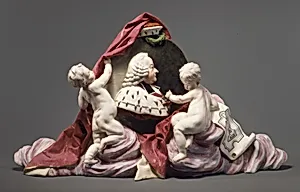
Emmerich Joseph, Prince-Bishop of Mainz
Medium
Hard-paste porcelain
Dimensions
9 1/4 × 16 × 4 3/4 in. (23.5 × 40.6 × 12.1 cm)
Classification
Ceramics-Porcelain
Culture
German, Höchst
Department
European Sculpture and Decorative Arts
Museum
Metropolitan Museum of Art, New York, NY
Credit
Gift of R. Thornton Wilson, in memory of Florence Ellsworth Wilson, 1945
Accession Number
45.61.2
Rights
Public Domain
Tags
Art Historical Context
This exquisite hard-paste porcelain sculpture, around 1770 by the Hö Manufactory with modeling by Johann Peter Melchior depicts Emmerich Joseph, Prince-Bishop of Mainz (1704–1774), surrounded by playful putti. Standing at nearly 16 inches wide, the piece exemplifies the Rococo style's love for elaborate, whimsical decoration, with the bishop's dignified portrait framed by cherubic figures symbolizing divine favor and ecclesiastical authority. Höchst, a pioneering German porcelain factory near Frankfurt founded in 1746, rivaled Meissen in producing true hard-paste porcelain—fired at high temperatures for a durable, translucent quality prized by Europe's elite. Melchior, one of its master sculptors, brought lifelike detail and dynamic poses to such figural groups, blending portraiture with fantasy. Emmerich Joseph, a key figure in the Holy Roman Empire's waning years, ruled Mainz amid Enlightenment tensions between church and state, making this work a snapshot of 18th-century princely power and piety. As a luxury decorative art, it highlights porcelain's role in courtly display, where religious leaders commissioned pieces to affirm status. Today, at The Metropolitan Museum of Art, it invites visitors to marvel at the technical virtuosity—vibrant polychrome glazes and intricate modeling—that captured fleeting aristocratic grandeur.