
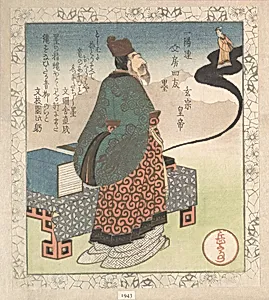
「一陽連文房四友 墨 玄宗皇帝」『春雨集』 摺物帖 |Emperor Xuanzong (Japanese: Gensō) and Daoist Magician Lo Gongyuan Arising from an Inkstone; “Ink” (Sumi), from Four Friends of the Writing Table for the Ichiyō Poetry Circle (Ichiyō-ren Bunbō shiyū)From the Spring Rain Collection (Harusame shū), vol. 1
ca. 1827
Medium
Woodblock print (surimono); ink and color on paper
Dimensions
8 x 7 1/16 in. (20.3 x 17.9 cm)
Classification
Prints
Culture & Period
Japan · Edo period (1615–1868)
Department
Asian Art
Museum
Metropolitan Museum of Art, New York, NY
Credit
H. O. Havemeyer Collection, Bequest of Mrs. H. O. Havemeyer, 1929
Accession Number
JP1943
Rights
Public Domain
Tags
Art Historical Context
In this enchanting woodblock print (surimono) from around 1827, Osaka artist Yashima Gaki captures a whimsical moment from the *Spring Rain Collection* (*Harusame shū*), volume 1. Titled *“Ink” (Sumi), from Four Friends of the Writing for the Ichiyō Circle*, it depicts Emperor Xuanzong ( as Gensō in Japanese) and the Daoist magician Lo Gong playfully emerging from an inkstone of the four essential tools of the literati (alongside brush, paper, and inkstone). Created during Japan's Edo period (1615–1868), this intimate 8 x 7-inch print on paper blends ink and vibrant color in Gakutei's signature delicate style. Surimono like this were luxurious, privately commissioned prints, often produced for poetry circles such as the Ichiyō-ren. They combined exquisite illustrations with kyōka (witty, 31-syllable poems), celebrating scholarly pursuits and folklore. Here, the fantastical scene draws on Chinese legends of Xuanzong's Tang dynasty court, reimagined with humor to personify "ink" as a magical companion, reflecting the playful fusion of Sino-Japanese culture in ukiyo-e art. Gakutei's mastery shines in the fine lines and subtle color gradients, evoking the refined aesthetic of Osaka printmaking. Part of the H. O. Havemeyer Collection at the Metropolitan Museum of Art, this piece highlights surimono's role in fostering elite literary communities, offering visitors a window into Edo Japan's poetic elegance.
About the Artist
Yashima Gakutei · 1786–1868
Yashima Gakutei (c. 1786–1868), born in Osaka as the illegitimate son of a Tokugawa shogunate samurai named Hirata, adopted the name from his mother's subsequent marriage into the Yashima clan. Little is documented about his early years beyond these familial ties, but he pursued artistic training under the esteemed ukiyo-e masters Totoya Hokkei and Katsushika Hokusai, absorbing their precision in ...