
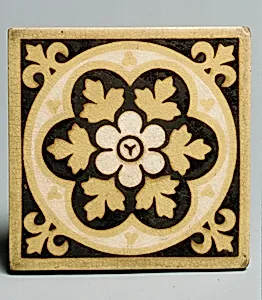
Encaustic Tile
Medium
Earthenware
Dimensions
4 5/16 x 4 5/16 x 1/2 in. (11 x 11 x 1.3 cm)
Classification
Encaustic tile
Culture
American
Department
The American Wing
Museum
Metropolitan Museum of Art, New York, NY
Credit
Gift of Florence I. Balasny-Barnes, in memory of her sister, Yvette B. Gould, 1984
Accession Number
1984.443.8
Rights
Public Domain
Art Historical Context
This encaustic tile, produced by the American Encaustic Tile Company between 1870 and 1875, captures a pivotal moment in the growth of American manufacturing. of earthenware and measuring just over four inches square, it reflects the era’s expanding industrial capabilities, as U.S. firms began producing durable, decorative tiles for homes and public buildings inspired by European traditions yet tailored to domestic needs. Encaustic tiles are distinguished by their technique of inlaying colored clays into the body of the tile before firing, creating patterns that resist fading even with heavy use. This method allowed for intricate, long-lasting designs that became popular in Victorian-era interiors, blending artistry with practicality in everyday American spaces. Now part of the Metropolitan Museum of Art’s American Wing, the tile offers insight into 19th-century decorative arts and the nation’s emerging identity in design. Its gift in memory of Yvette B. Gould reminds visitors of the personal connections that enrich museum collections, highlighting both technical skill and cultural heritage.