
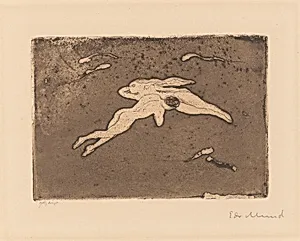
Encounter in Space (Møte i verdensrommet)
1902
Medium
etching and open bite on wove paper
Dimensions
plate: 12.9 × 18.7 cm (5 1/16 × 7 3/8 in.) sheet: 24.8 × 32 cm (9 3/4 × 12 5/8 in.)
Classification
Department
CG-E
Museum
National Gallery of Art, Washington, D.C.
Credit
Epstein Family Collection
Accession Number
2021.101.12
Rights
Public Domain
Art Historical Context
Edvard Munch's *Encounter in Space (Møte i verdensmet)*, created in 1902, the Norwegian artist's fascination with existential themes during a pivotal period in his career. Best known for his iconic *The Scream*, Munch was a pioneer of Expressionism, channeling inner turmoil, love, and into distorted forms and vivid emotions. This print reflects his early 20th-century explorations of psychological and cosmic encounters, blending Symbolist influences with emerging modernist sensibilities amid Europe's fin-de-siècle anxieties. Executed as an etching and open bite on wove paper, the work showcases Munch's mastery of intaglio printmaking. Etching involves incising lines into a metal plate with acid for precise, expressive marks, while open bite exposes larger areas to create bold, textured depths—techniques that allowed Munch to evoke ethereal, otherworldly atmospheres on a modest scale (plate: 12.9 × 18.7 cm). Prints like this democratized his art, making it accessible beyond paintings and influencing generations of printmakers. Housed in the National Gallery of Art's Epstein Family Collection, *Encounter in Space* highlights Munch's innovative graphic legacy, bridging personal dread with universal mysteries. A testament to his prolific print output of over 200 editions, it invites visitors to ponder the infinite voids of human connection.
About the Artist
Edvard Munch · 1863–1944
Edvard Munch (1863-1944) was a Norwegian painter and printmaker whose intensely psychological works made him a pioneer of Expressionism and one of the most influential artists of the modern era. His 1893 masterpiece 'The Scream' has become an iconic symbol of existential anxiety. Munch's art was profoundly shaped by personal tragedy—his mother died when he was five, his beloved sister Sophie at fo...