
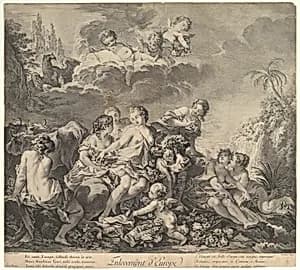
Enlevement d'Europe (Abduction of Europa)
18th century
Medium
Etching and engraving
Dimensions
Sheet: 16 15/16 x 18 11/16 in. (43 x 47.5 cm)
Classification
Prints
Department
Drawings and Prints
Museum
Metropolitan Museum of Art, New York, NY
Credit
The Elisha Whittelsey Collection, The Elisha Whittelsey Fund, 1965
Accession Number
65.686.3
Rights
Public Domain
Tags
Art Historical Context
This 18th-century etching and engraving captures the dramatic myth of Europa’s abduction, in which the god Jupiter, disguised as a bull, carries the young woman across the sea. François Boucher, a leading figure of the French Rococo movement, designed the lively composition, while printmaker Pierre Alexandre Aveline translated it into this detailed reproductive print. The work exemplifies the period’s fascination with classical mythology, rendered through graceful figures, playful putti, and lush natural details that appealed to aristocratic collectors. Etching and engraving allowed such elegant designs to reach wider audiences beyond the original painting, showcasing the Rococo taste for light, sensual subjects and ornate decoration. Visible in the scene are Europa’s nude form, the powerful bull, fluttering birds, and Cupid figures, all rendered with fine lines that convey movement and texture. Housed in the Metropolitan Museum of Art’s collection of drawings and prints, this sheet highlights how reproductive prints preserved and popularized Boucher’s mythological visions throughout Europe.