
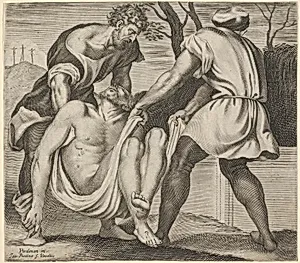
Entombment of Christ, two men lifting Christ into a tomb, with a shroud underneath the body, three crosses on Golgotha beyond, from a series of five engravings after the destroyed or detached frescoes of 1532/33 by Giovanni Antonio da Pordenone in the cloister of S.Stefano, Venice
Medium
Engraving
Dimensions
sheet: 6 1/4 x 7 1/8 in. (15.9 x 18.1 cm)
Classification
Prints
Department
Drawings and Prints
Museum
Metropolitan Museum of Art, New York, NY
Credit
Bequest of Phyllis Massar, 2011
Accession Number
2012.136.292
Rights
Public Domain
Tags
Art Historical Context
This engraving captures a poignant moment from the Passion of Christ, showing two men carefully lowering his body into a tomb, with the burial shroud visible beneath. In the background, three crosses stand on Golgotha, evoking the crucifixion that has just taken place. Created around 1656 by Giacomo Piccini, the print faithfully reproduces a now-lost fresco painted in 1532–33 by Giovanni Antonio da Pordenone (also known as Giovanni Antonio de Sacchis) for the cloister of Santo Stefano in Venice. Pordenone, a leading Venetian artist of the High Renaissance, was celebrated for his dynamic compositions and expressive figures. Although the original frescoes have been destroyed or detached, Piccini’s series of five engravings preserves their essential designs for later generations. As a print medium, the engraving allowed these powerful religious images to circulate widely, bringing the drama of Pordenone’s work beyond the walls of the Venetian monastery. Today, this sheet in the Metropolitan Museum’s collection offers visitors a rare glimpse into a vanished chapter of Renaissance art. Its modest size—roughly six by seven inches—belies the emotional weight and historical importance of the scene it records.
About the Artist
Giacomo Piccini|Giovanni Antonio da Pordenone (Giovanni Antonio de Sacchis) (Italian|Italian|Italian) · 1575 | |1635 –1642 | |1691
Italian, Bologna 1575–1642 Bologna|Italian, born Venice, ca. 1617|Italian, born Brescia, active Venice, ca. 1640–1691