
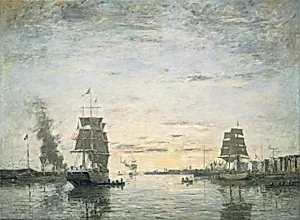
Entrance to the Harbor, Le Havre
1883
Medium
oil on canvas
Dimensions
overall: 118.6 x 160.2 cm (46 11/16 x 63 1/16 in.) framed: 142.9 x 192.7 cm (56 1/4 x 75 7/8 in.)
Classification
Painting
Department
CF
Museum
National Gallery of Art, Washington, D.C.
Credit
Collection of Mr. and Mrs. Paul Mellon
Accession Number
1983.1.16
Rights
Public Domain
Art Historical Context
Step into the bustling *Entrance to the Harbor, Le Havre* (1883), a masterful oil on canvas by Eugène Boudin, capturing the vibrant energy of Normandy's iconic port city. Boudin, a pioneering French marine painter (1824–1898), devoted his career to depicting coastal scenes en plein air—painting outdoors to seize fleeting atmospheric effects. This expansive work (118.6 x 160.2 cm) immerses viewers in Le Havre's harbor mouth, where ships glide amid shimmering waves under a vast, luminous sky, evoking the industrial vitality of late 19th-century France. As a precursor to Impressionism, Boudin's loose brushwork and subtle color gradations emphasize light's play on water and clouds, techniques he passed to protégé Claude Monet. The large-scale oil medium allowed rich, layered impasto for textured seas and glowing horizons, blending realism with impressionistic freedom. Housed in the National Gallery of Art's Paul Mellon Collection, it highlights Boudin's enduring influence on modern landscape art. Fun fact: Le Havre, a key trade hub, inspired many of Boudin's 1,000+ seascapes—perfect for imagining salty breezes on a gallery stroll!
About the Artist
Eugène Boudin · 1824–1898
Eugène Louis Boudin was born on July 12, 1824, in Honfleur, Normandy, the son of a harbor pilot. When his family relocated to Le Havre, his father opened a stationery and picture-framing shop, and it was there that the young Boudin first encountered working artists. Artists such as Constant Troyon and Jean-François Millet recognized his talent and urged him toward a career in art. In 1850, a munic...