
Environs de Choisy-le-Roi
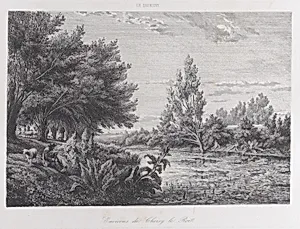
Medium
Etching; third state of three
Dimensions
Sheet: 8 13/16 × 12 1/16 in. (22.4 × 30.6 cm) Image: 6 5/8 × 9 5/8 in. (16.9 × 24.4 cm)
Classification
Prints
Department
Drawings and Prints
Museum
Metropolitan Museum of Art, New York, NY
Credit
Gift of Madeleine Fidell-Beaufort, in memory of Charles Theodore Price, 2018
Accession Number
2018.906.2
Rights
Public Domain
Tags
Art Historical Context
Charles-François Daubigny’s *Environs de Choisy-le-Roi* (1843) captures the serene landscapes along the Seine River near Paris, a favored motif for the artist in his early career. Daubigny, a key figure in the Barbizon School, bridged Romanticism and the emerging Realism of the mid-19th century. This etching reflects his fascination with nature’s quiet beauty, sketching directly from life to evoke the subtle play of light on water and foliage—foreshadowing Impressionist techniques he would later inspire in artists like Monet. Printed as the third and final state of three, this etching demonstrates Daubigny’s mastery of intaglio printmaking. Using acid to etch fine lines into a metal plate, he achieved delicate textures for trees, riverbanks, and atmospheric depth within the modest image size of 6⅝ × 9⅝ inches. Etchings like this were prized for their reproducibility, allowing wider access to an artist’s vision during a time when original paintings were elite luxuries. Now in The Metropolitan Museum of Art’s Drawings and Prints department, this work—gifted in 2018—offers visitors a window into Daubigny’s innovative approach to landscape art. Its intimate scale invites close inspection, revealing the technical precision that made his prints collector favorites in 19th-century France.
About the Artist
Charles-François Daubigny · 1817–1878
Charles-François Daubigny was born on February 15, 1817, in Paris into a family of artists, with his father, Edmé-François Daubigny, a classical landscape painter, and his uncle, Pierre Daubigny, a miniaturist, providing his initial artistic training. He further studied under Jean-Victor Bertin, Jacques Raymond Brascassat, and Paul Delaroche at the École des Beaux-Arts, though he quickly moved bey...