
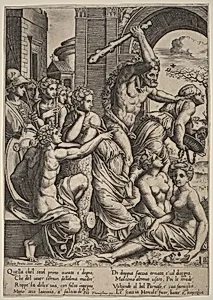
Envy Driven from the Temple of the Muses
1401 to 1500
Medium
engraving
Classification
Department
CG-E
Museum
National Gallery of Art, Washington, D.C.
Credit
Rosenwald Collection
Accession Number
1943.3.5830
Rights
Public Domain
Art Historical Context
In the National Gallery of Art's Rosenwald Collection, *Envy Driven from the Temple of the Muses* is a striking 15th-century engraving by the anonymous Master of the Die, created after a design by the Italian Renaissance artist Baldassare Peruzzi. Dating to between 1401 and1500, this print the era's fascination with classical mythology and moral allegory. Peruzzi, renowned for his architectural frescoes and stage designs in Siena and Rome, provided the compositional blueprint, which the Master faithfully reproduced through intricate line work. The scene dramatically depicts the personified vice of Envy being forcibly expelled from the sacred Temple of the Muses—nine goddesses embodying poetry, music, and the arts. This Renaissance motif symbolizes the triumph of creative inspiration over destructive jealousy, reflecting humanism's emphasis on virtue and intellectual pursuit during Italy's cultural rebirth. As an engraving, the work highlights a pivotal printmaking technique: lines incised into a metal plate with a burin, allowing ink to transfer to paper for multiple impressions. This innovation democratized access to high art, spreading Peruzzi's elegant, balanced compositions far beyond elite patrons and influencing later graphic traditions in the CG-E Prints Department. A testament to collaborative artistry, it invites us to celebrate the enduring power of the Muses.