
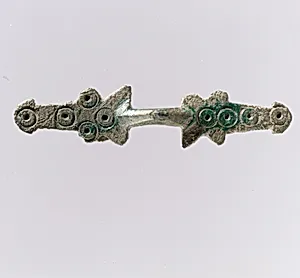
Equal-Arm Brooch
Unknown Artist
7th–8th century
Medium
Copper alloy
Dimensions
Overall: 2 1/4 x 7/16 x 1/2 in. (5.7 x 1.1 x 1.3 cm)
Classification
Metalwork-Copper alloy
Culture
Frankish
Department
Medieval Art
Museum
Metropolitan Museum of Art, New York, NY
Credit
Gift of J. Pierpont Morgan, 1917
Accession Number
17.191.236
Rights
Public Domain
Art Historical Context
This delicate Equal-Arm Brooch crafted by an unknown Frankish artisan in the 7th–8th century, exemplifies the metalworking of early medieval Europe. Measuring just 2¼ x 7/16 x ½ inches, its symmetrical design—characteristic of "equal-arm" brooches—features two balanced arms converging at a central point, likely fitted with a pin mechanism for cloaks or garments. Made from copper alloy, a durable and accessible material, it highlights the Franks' skill in casting and shaping metal for both functional and ornamental purposes. Originating from the Frankish culture during the Merovingian period, this brooch reflects a time when the Franks dominated much of western Europe, blending Roman influences with Germanic traditions. Such jewelry was not merely practical; it served as a status symbol, often worn in pairs by elites and sometimes found in burials, offering glimpses into daily life and social hierarchies. Its presence in the Metropolitan Museum of Art's Medieval Art Department, gifted by J. Pierpont Morgan in 1917, underscores its value as a tangible link to a formative era before the Carolingian Renaissance. Though modest in scale, the brooch's precise craftsmanship reveals the artistic ingenuity of Frankish metalworkers, who transformed everyday copper alloy into enduring artifacts of cultural pride.