
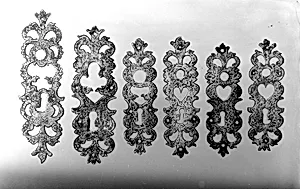
Escutcheon
Unknown Artist
1730–70
Medium
Wrought iron
Dimensions
H. 6 3/16 in. (15.7 cm)
Classification
Escutcheon
Culture
American
Department
The American Wing
Museum
Metropolitan Museum of Art, New York, NY
Credit
Gift of Mrs. J. Insley Blair, 1949
Accession Number
49.117.10
Rights
Public Domain
Art Historical Context
Nestled in The American Wing of the Metropolitan Museum Art, this delicate *Escutcheon* from 1730–70 exemplifies refined craftsmanship of colonial American ironwork. Crafted from wrought iron by an unknown artisan, this small protective plate—measuring just 6 3/16 inches (15.7 cm) in height—was likely designed to shield keyholes or hinges on doors and furniture, blending utility with subtle elegance. Donated in 1949 by Mrs. J. Insley Blair it offers a tangible glimpse into everyday life in early America. Wrought iron, hammered and shaped by hand over an anvil, was a hallmark of 18th-century blacksmithing, prized for its malleability and strength. This medium allowed skilled makers to create intricate scrolls, piercings, and curves that elevated functional hardware into decorative art. During the colonial period, such escutcheons adorned homes of the emerging merchant class, reflecting European influences like Queen Anne or Georgian styles adapted to local resources and tastes. Though modest in scale, this piece highlights the cultural importance of ironwork in shaping American identity—where immigrant traditions met frontier ingenuity. Visitors can appreciate how these unassuming objects preserved wealth and status, turning the mundane into the memorable.