
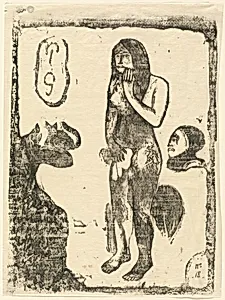
Eve
1898-1899
Medium
woodcut on Japan paper
Dimensions
sheet: 30.4 × 22.7 cm (11 15/16 × 8 15/16 in.)
Classification
Department
CG-E
Museum
National Gallery of Art, Washington, D.C.
Credit
Rosenwald Collection
Accession Number
1948.11.117
Rights
Public Domain
Art Historical Context
Paul Gauguin's *Eve*, created between 1898 and 1899, captures the artist's fascination with primal myths and exotic paradises during his time initi. As a Post-Impressionist, Gauguin drew from biblical narratives like the Garden of Eden, reimagining Eve with bold, symbolic forms that blend Western symbolism and Polynesian influences. This woodcut on delicate Japan paper—thin, absorbent, and prized for its clarity—reflects his immersion in non-Western aesthetics, echoing Japanese ukiyo-e prints that inspired European artists of the era. Printed from carved wood blocks, the medium allowed Gauguin to achieve stark contrasts and simplified contours, hallmarks of his Primitivist style. At just 30.4 × 22.7 cm, the intimate scale invites close viewing, revealing textured lines that evoke tattoo-like patterns and lush island motifs. Part of the National Gallery of Art's Rosenwald Collection, this print exemplifies Gauguin's experimental printmaking in his later years, bridging fine art and popular reproduction while challenging colonial views of the "primitive." Though small, *Eve* embodies Gauguin's quest for spiritual renewal, making it a poignant window into his revolutionary vision that influenced modern art.
About the Artist
Paul Gauguin · 1848–1903
Paul Gauguin (1848-1903) was a French Post-Impressionist painter whose bold experiments with color, form, and subject matter made him one of the most influential figures in the transition from 19th-century art to modernism. His rejection of European civilization for the perceived authenticity of 'primitive' cultures established an archetype of artistic exile that continues to resonate. Gauguin's ...