
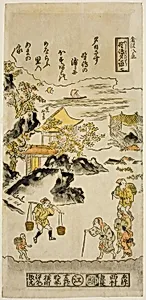
Evening Glow at Nojima (Nojima no sekisho), No. 7 from the series "Eight Views of Kanazawa (Kanazawa hakkei)"
c. 1716/36
Medium
Hand-colored woodblock print; hosoban, urushi-e
Dimensions
33.7 × 16.2 cm (13 1/4 × 6 3/8 in.)
Classification
woodblock print
Department
Arts of Asia
Museum
Art Institute of Chicago
Accession Number
88895
Rights
Public Domain
Art Historical Context
**Evening Glow at Nojima (Nojima no sekisho)**, No. 7 from Nishimura Shigenaga's *Eight Views of Kanazawa (Kan hakkei)*, captures poetic beauty of Japan's Ishikawa Prefecture around 1716–1736.igenaga, an early ukiyo-e master active in Edo (modern Tokyo), drew inspiration from traditional Chinese landscape motifs like the "Eight Views of-Xiang." This narrow-format print spotlights Nojima's checkpoint bathed in a warm evening glow, evoking the serene "floating world" ethos of everyday poetry amid nature. Printed as a *hosoban urushi-e*—a slim, hand-colored woodblock measuring just 33.7 × 16.2 cm—this artwork showcases innovative early techniques. The *urushi-e* (lacquer print) method used a glue-like adhesive for a glossy sheen and vibrant color retention, bridging monochrome *sumizuri-e* and later multicolored masterpieces by artists like Hiroshige. Hand-applied pigments heightened the sunset's luminosity, making these affordable prints popular souvenirs for urbanites. Housed in the Art Institute of Chicago's Arts of Asia collection, this piece highlights Kanazawa's cultural allure during the Edo period, when regional views celebrated Japan's provincial splendor. Shigenaga's refined lines and atmospheric depth invite visitors to savor the fleeting magic of dusk, a timeless reminder of ukiyo-e's enduring charm.
About the Artist
Nishimura Shigenaga · 1690–1758
Nishimura Shigenaga (c. 1697–1756) was a pioneering Japanese ukiyo-e printmaker born in Edo (modern-day Tokyo), where he initially worked as a landlord in the Tōriabura-chō district before relocating to Kanda-Sakumachō to operate a bookshop. Self-taught with no known formal teacher, he immersed himself in art around 1719, drawing early inspiration from the Torii school's yakusha-e (actor portraits...