
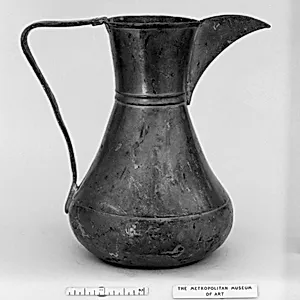
Ewer
Unknown Artist
late 16th–early 17th century
Medium
Pewter
Dimensions
6 1/2 × 4 1/4 in. (16.5 × 10.8 cm)
Classification
Metalwork-Pewter
Culture
Dutch or Flemish
Department
European Sculpture and Decorative Arts
Museum
Metropolitan Museum of Art, New York, NY
Credit
Gift of Mr. R.M. Parmelee and Mrs. W.L. Parker, 1916
Accession Number
16.116.138
Rights
Public Domain
Art Historical Context
This elegant pewter ewer, crafted in the late 16th early 17th century an unknown Dutch or Flemish artisan, stands as a fine example of everyday luxury from Northern Europe's Renaissance era. Measuring just 6½ × 4¼ inches, its compact form—likely featuring a spout, handle, flared base typical of the period—made it ideal for pouring water or wine at the table. Pewter, an alloy primarily of tin with traces of lead or other metals, offered a silvery sheen and durability at a fraction of silver's cost, bridging the gap between humble pottery and elite silverware. Hailing from the prosperous Low Countries during the Dutch Golden Age's dawn, this ewer reflects the region's booming trade and skilled metalworking guilds, centered in cities like Antwerp and Delft. Artisans employed techniques such as casting, hammering, and chasing to create functional yet refined objects, symbolizing rising middle-class affluence amid religious and political upheavals like the Dutch Revolt. Today, housed in the Metropolitan Museum of Art's European Sculpture and Decorative Arts department (gift of Mr. R.M. Parmelee and Mrs. W.L. Parker, 1916), it invites us to ponder the artistry in daily life—how a simple vessel embodied craftsmanship, commerce, and cultural pride.