
Ewer
Unknown Artist
probably 18th–19th century
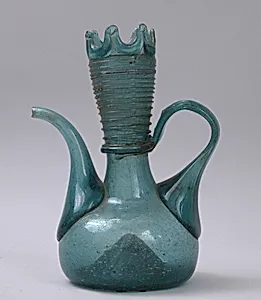
Medium
Glass; free blown with applied decoration
Dimensions
H. 6 3/8 in. (16.2 cm) Diam. 3 7/16 in. (8.8 cm)
Classification
Glass
Department
Islamic Art
Museum
Metropolitan Museum of Art, New York, NY
Credit
Gift of Samuel L. M. Barlow, 1883
Accession Number
83.6.14
Rights
Public Domain
Art Historical Context
This elegant glass ewer, dating to the 18th or 19th century, hails from the Islamic world and exemplifies the refined craftsmanship of traditional glassmaking. Standing just over 6 inches tall with a diameter of about 3½ inches, it was created using the free-blown technique, where molten glass skillfully blown into shape without a mold, allowing for fluid, organic forms. Delicate applied decorations—likely trails or threads of glass added while hot—enhance its, adding texture and visual interest that catches the light beautifully. In the context of Islamic art, such ewers were essential vessels for pouring water during ablutions, rituals, or daily hospitality, blending utility with artistry. Free-blown glass with applied motifs was a hallmark of workshops in regions like Syria, Egypt, or the Ottoman Empire, where artisans pushed the boundaries of transparency and color. This piece highlights the era's technical mastery, as glassmakers achieved thin walls and intricate details without modern tools. A generous gift to the Metropolitan Museum of Art in 1883 from Samuel L. M. Barlow, this ewer invites visitors to appreciate the everyday elegance of Islamic material culture, where even functional objects became works of subtle splendor.