
Ewer
Unknown Artist
late 12th–early 13th century
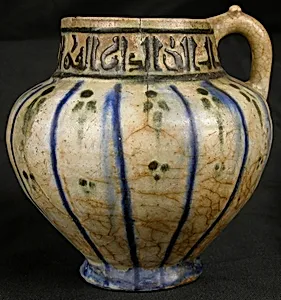
Medium
Stoneware; underglaze painted and carved through black slip under colorless glaze
Dimensions
H. 4 7/8 in. (12.4 cm) Diam.4 7/8 in. (12.4 cm)
Classification
Ceramics
Department
Islamic Art
Museum
Metropolitan Museum of Art, New York, NY
Credit
Gift of Smith Ely Goldsmith, 1993
Accession Number
1993.434
Rights
Public Domain
Art Historical Context
This elegant ewer, crafted in the late 12th to early 13th century, exemplifies the refined ceramic artistry of the Islamic world. Standing just under 5 inches tall with a matching diameter, this stoneware vessel—likely used for pouring water or liquids in daily rituals or hospitality—was shaped into a graceful, spout-bearing form ideal for both function and display. Its anonymous maker employed sophisticated techniques: a black slip was applied over the body, then incised and painted with underglaze designs before a clear glaze sealed the surface, creating a glossy, durable finish that highlights intricate patterns. The use of stoneware, fired at high temperatures for exceptional strength, marked a technical pinnacle in Islamic ceramics during this era, rivaling Chinese imports and enabling widespread trade across the Middle East and beyond. The sgraffito-like carving through slip reveals contrasting layers, a method that allowed artisans to evoke floral motifs or geometric motifs without forbidden figurative imagery, aligning with Islamic aniconism while showcasing mathematical precision and beauty. Housed in the Metropolitan Museum of Art's Islamic Art department through a 1993 gift, this ewer invites visitors to appreciate how everyday objects became canvases for cultural splendor, bridging utility and artistry in medieval Islamic society.