
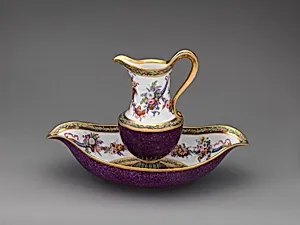
Ewer and basin
Medium
Hard-paste porcelain
Dimensions
Height (ewer): 10 in. (25.4 cm); Width (basin): 15 3/4 in. (40 cm)
Classification
Ceramics-Porcelain
Culture
French, Sèvres
Department
European Sculpture and Decorative Arts
Museum
Metropolitan Museum of Art, New York, NY
Credit
Purchase, Mrs. Sid R. Bass Gift, in honor of Mrs. Charles Wrightsman, 2004
Accession Number
2004.158a, b
Rights
Public Domain
Tags
Art Historical Context
This elegant ewer and basin, crafted in 1795 by François Antoine Pfeiffer, Gilbert Drouet, and the renowned Sèvres Manufactory, exemplifies the pinnacle of French porcelain artistry during the Directory period following the Revolution. Made from hard-paste porcelain—a durable, translucent material perfected by Europeans after centuries of imitating Chinese techniques—these pieces measure 10 inches high for the ewer and 15¾ inches wide for the basin. Produced at Sèvres, the royal factory near Paris, they reflect a shift from opulent ancien régime styles toward neoclassical restraint, yet retain exquisite decorative flair. Sèvres porcelain was a symbol of French luxury and technical innovation, prized by aristocracy and revolutionaries alike. The floral motifs, likely hand-painted and gilded, highlight the manufactory's mastery of intricate overglaze enameling and gold detailing, techniques that demanded exceptional skill to withstand high kiln temperatures. These functional yet sculptural objects served for personal grooming or handwashing, blending utility with high art. Today, housed in The Metropolitan Museum of Art's European Sculpture and Decorative Arts department, this set—acquired in 2004—offers a glimpse into post-Revolutionary elegance, where porcelain bridged old-world refinement and emerging democratic tastes. A true treasure for admirers of 18th-century design!
About the Artist
François Antoine Pfeiffer|Sèvres Manufactory|Gilbert Drouet (French|French) · 1740 |1771 –9999 |1800
French, 1740–present|French, active 1771–1800