
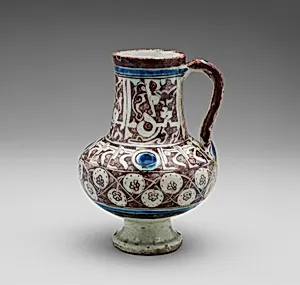
Ewer Inscribed with "al-'izz" ("Glory") in Floriated Kufic on its Neck
Unknown Artist
first half 13th century
Medium
Stonepaste; painted in luster and blue on opaque white glaze under transparent glaze
Dimensions
H. 7 5/16 in. (18.6 cm) Gr. Diam. 5 1/8 in. (13 cm)
Classification
Ceramics
Department
Islamic Art
Museum
Metropolitan Museum of Art, New York, NY
Credit
H.O. Havemeyer Collection, Gift of Horace Havemeyer, 1948
Accession Number
48.113.18
Rights
Public Domain
Art Historical Context
This elegant ewer, crafted in the first half of the 13 century, exemplifies the pinnacle of medieval Islamic ceramics. Made from stonepaste—a composite material of quartz, clay, and frit that allowed artisans to create porcelain-like vessels—it stands just over 7 inches tall with a graceful neck and bulbous body. The surface is adorned with an opaque white glaze overpainted in shimmering luster and cobalt blue, then sealed under a transparent glaze. This lusterware technique, developed in the Islamic world around the 9th century and perfected in centers like Iran and Syria, produced a metallic iridescence that caught the light like gold, making such objects symbols of luxury for elite households and courts. Encircling the neck is the inscription "al-'izz" ("Glory") rendered in floriated Kufic script, a highly decorative angular style where letters bloom into floral motifs. This calligraphic flourish not only conveys auspicious blessings but also highlights the fusion of artistry and spirituality in Islamic culture, where writing was revered as a sacred art. Ewers like this were practical for ablutions or serving beverages, yet their opulent decoration elevated them to status pieces. Housed in the Metropolitan Museum of Art's Islamic Art department as part of the H.O. Havemeyer Collection (gift of Horace Havemeyer, 1948), this anonymous masterpiece invites us to marvel at the ingenuity of 13th-century potters, whose innovations influenced ceramics across Eurasia.