
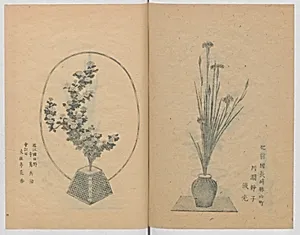
Examples of the Flower Arrangement (Meiji shinsen risshō senkashiki) 明治新撰千花式
1889
Medium
Ink on paper
Dimensions
8 3/4 × 6 1/8 × 3/8 in. (22.2 × 15.6 × 1 cm)
Classification
Illustrated Books
Culture & Period
Japan · Meiji period (1868–1912)
Department
Asian Art
Museum
Metropolitan Museum of Art, New York, NY
Credit
The Howard Mansfield Collection, Gift of Howard Mansfield, 1936
Accession Number
JIB119
Rights
Public Domain
Tags
Art Historical Context
Discover the delicate artistry of *Examples of the Flower ArrangementMeiji shinsen rissō senkashiki)*, a captivating illustrated book created by Japanese ikebana master Yagi Sekkei in 1889. This compact volume (8 3/4 × 6 1/8 × 3/8 in.), rendered in precise ink on paper, presents a "newly selected" collection of thousand flower styles, offering practical guidance and visual inspiration for traditional Japanese flower arranging. Housed in the Metropolitan Museum of Art's Art Department as part of The Howard Mansfield Collection, it exemplifies Meiji-period craftsmanship. During Japan's Meiji era (1868–1912), rapid modernization coexisted with cherished cultural traditions like ikebana, which emphasizes harmony between flowers, branches, and vessels to evoke nature's fleeting beauty. Yagi Sekkei's work reflects this balance, preserving classical techniques amid Western influences. The book's meticulous illustrations highlight seasonal flora, teaching viewers the rhythmic asymmetry and minimalist elegance central to ikebana schools. As a cultural artifact, it underscores flower arrangement's deeper significance in Japanese aesthetics—symbolizing impermanence (mono no aware) and spiritual mindfulness. Leaf through its pages to appreciate how ink captured ephemeral blooms, bridging art, nature, and philosophy in one enduring treasure.