
藤原 行成書 白居易作 「醉吟先生傳」断簡|Excerpt from Bai Juyi's "Autobiography of a Master of Drunken Poetry Recitation"
early 11th century
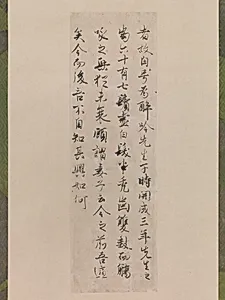
Medium
Handscroll section mounted as a hanging scroll; ink on paper
Dimensions
Image: 10 13/16 × 3 3/8 in. (27.5 × 8.6 cm) Overall with mounting: 53 1/8 × 11 1/16 in. (134.9 × 28.1 cm) Overall with knobs: 53 1/8 × 12 7/8 in. (134.9 × 32.7 cm)
Classification
Calligraphy
Culture & Period
Japan · Heian period (794–1185)
Department
Asian Art
Museum
Metropolitan Museum of Art, New York, NY
Credit
Gift of Raymond and Priscilla Vickers, 2016
Accession Number
2016.745
Rights
Public Domain
Art Historical Context
This exquisite calligraphy fragment, created by the renowned Heian-period master Fujiwara no Yukinari (also known as Kōzei) in the early 11th century, preserves an excerpt from the Tang-dynasty Chinese poet Bai Juyi’s “Autobiography of a Master of Drunken Poetry Recitation.” During Japan’s Heian period, aristocratic culture flourished through the study and adaptation of Chinese literary classics, and Kōzei’s elegant brushwork exemplifies the refined taste of the era. As one of the “Three Brush Traces,” he helped define a distinctly Japanese calligraphic style that balanced Chinese models with native sensitivity. Originally part of a longer handscroll, this delicate ink-on-paper section has been remounted as a hanging scroll, allowing viewers to appreciate its intimate scale and fluid strokes up close. The medium itself reflects the Heian preference for portable, personal formats that invited quiet contemplation. Today, the work offers a rare glimpse into the cultural exchange between China and Japan, as well as the high regard in which poetry and calligraphy were held among the Heian elite.