
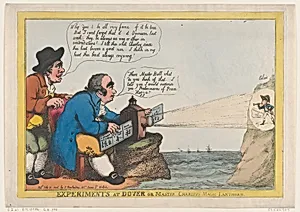
Experiments at Dover or Master Charley's Magic Lanthorn
July 21, 1806
Medium
Hand-colored etching
Dimensions
Sheet: 11 7/16 × 16 1/4 in. (29.1 × 41.3 cm) Plate: 11 1/8 × 15 1/4 in. (28.3 × 38.8 cm)
Classification
Prints
Department
Drawings and Prints
Museum
Metropolitan Museum of Art, New York, NY
Credit
The Elisha Whittelsey Collection, The Elisha Whittelsey Fund, 1959
Accession Number
59.533.957
Rights
Public Domain
Tags
Art Historical Context
Thomas Rowlandson's *Experiments at Dover or Master Charley's Magicanthorn* (1806) is a vibrant hand-colored etching that exemplifies the artist's mastery of satirical caricature during the Napoleonic Wars. Created as Britain faced the threat of French invasion, the print humorously skewers Napoleon I—likely dubbed "Master Charley" inisive British fashion—amid political tensions. Dover, a key Channel port, serves as the backdrop for this whimsical scene, poking fun at Napoleon's grandiose ambitions through the absurd metaphor of a "magic lanthorn," an early projection device used for lantern shows. Rowlandson, a leading figure in Georgian satire, employed etching with meticulous hand-coloring to heighten the visual punch of his exaggerated figures and chaotic compositions. This technique, popular in early 19th-century printmaking, allowed for affordable dissemination of political commentary to a wide audience, blending sharp wit with vivid hues. The work captures the era's cultural zeitgeist: Britons' defiant mockery of their emperor foe, turning fear into farce. Housed in the Metropolitan Museum of Art's Drawings and Prints department, this piece from The Elisha Whittelsey Collection highlights how satire served as both entertainment and propaganda, reminding us of art's power to lampoon the powerful.
About the Artist
Thomas Rowlandson · 1756–1827
Thomas Rowlandson (1757–1827) was an English artist and caricaturist whose satirical watercolors and prints captured the social life of Georgian Britain with unparalleled wit and technical mastery. Alongside James Gillray, he is recognized as one of the greatest British graphic artists, and his distinctive flowing line and keen observations have made his work integral to understanding late 18th an...