
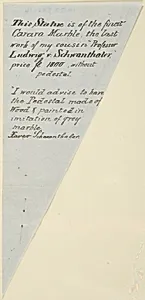
Explanatory note relating to sculpture of Nymphy by Ludwig Michael von Schwanthaler
ca. 1850
Medium
Pen and black ink on gray paper
Classification
Manuscripts
Department
Drawings and Prints
Museum
Metropolitan Museum of Art, New York, NY
Credit
Gift of Mrs. John De Witt Peltz, 1977
Accession Number
1977.382.16
Rights
Public Domain
Art Historical Context
In the Metropolitan Museum of Art Drawings and Prints department, intriguing *Explanatory note relating to sculpture of Ny by Ludwig Michael von Schwanaler* (ca. 1850) offers a fascinating glimpse into 19th-century artistic collaboration. Created by Franz Xaver Schthaler, a leading Bavarian sculptor of the Neoclassical era, the work is rendered in pen and black ink gray paper and classified as a manuscript. Donated in 1977 by Mrs. John De Witt Peltz it serves as a textual and possibly illustrative companion to a sculpture of the mythological nymph by Schwanthaler's son, Ludwig Michael von Schwanthaler. The Schwanthalers were a dynasty of sculptors based in Munich, renowned for their monumental works adorning public buildings like the Glyptothek and the new Hofburg in Vienna. Franz Xaver (1808–1881), trained in classical antiquity, bridged Neoclassicism and emerging historicism, while his son Ludwig (1817–1898) expanded this legacy with grand, narrative-driven pieces. This note, likely a preparatory annotation or diagram, highlights the intimate father-son dynamic and the meticulous planning behind large-scale sculptures—reflecting the era's emphasis on precision in translating classical myths into marble or bronze. Nymph figures evoked timeless ideals of beauty and nature in Romantic-era art, symbolizing harmony between humanity and the divine. As a rare surviving document, it underscores the intellectual labor behind sculpture, inviting visitors to appreciate not just the final form but the creative process that brought ethereal nymphs to life.