
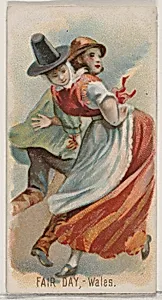
Fair Day, Wales, from the Holidays series (N80) for Duke brand cigarettes
Medium
Commercial color lithograph
Dimensions
Sheet: 2 3/4 x 1 1/2 in. (7 x 3.8 cm)
Classification
Prints|Ephemera
Department
Drawings and Prints
Museum
Metropolitan Museum of Art, New York, NY
Credit
The Jefferson R. Burdick Collection, Gift of Jefferson R. Burdick
Accession Number
63.350.204.80.51
Rights
Public Domain
Art Historical Context
Step into the lively world of late 19th-century advertising with *Fair Day, Wales*, charming chromolithograph from the Holidays series (N80) by W. Duke, Sons & Co. in collaboration with George S. Harris Sons. Created in 1890, this tiny print (just 2¾ x 1½ inches) was tucked into packs of Duke brand cigarettes as a collectible insert, enticing smokers to buy more for the full set. Depicting a festive Welsh fair, it captures the joy of holidays with vibrant crowds, stalls, and traditional merriment, offering a glimpse into Victorian-era leisure and regional culture. Chromolithography, the medium here, was a revolutionary color printing technique that allowed mass production of vivid, multi-hued images affordably—perfect for ephemera like these trade cards. Duke's innovative cards sparked a collecting craze, transforming everyday tobacco products into coveted albums filled with global scenes, from holidays to sports. This commercial art bridged fine printing and popular culture, showcasing the era's booming lithography industry in Philadelphia, home to Harris & Sons. Today, preserved in the Metropolitan Museum of Art's Jefferson R. Burdick Collection, *Fair Day, Wales* highlights how disposable promotions became historical treasures. It reminds us of advertising's power to preserve everyday life, inviting us to appreciate these pocket-sized windows into a bygone festive spirit.
About the Artist
W. Duke, Sons & Co.|George S. Harris & Sons · 1870–1920
**W. Duke, Sons & Co.: Pioneers of Chromolithographic Trade Card Art** W. Duke, Sons & Co., an American tobacco manufacturer, emerged from the entrepreneurial vision of Washington Duke (1820–1905) and his sons in Durham, North Carolina. After the Civil War, Washington abandoned farming in 1874 to join his eldest son, Brodie L. Duke, in the burgeoning tobacco trade, establishing a factory that for...