
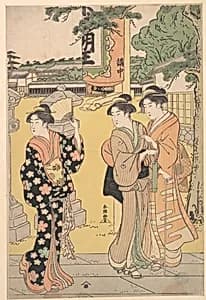
Fair Visitors in the Compound of a Buddhist Temple
ca. 1789
Medium
One sheet of a triptych of woodblock prints; ink and color on paper
Dimensions
15 x 10 in. (38.1 x 25.4 cm)
Classification
Prints
Culture & Period
Japan · Edo period (1615–1868)
Department
Asian Art
Museum
Metropolitan Museum of Art, New York, NY
Credit
The Howard Mansfield Collection, Purchase, Rogers Fund, 1936
Accession Number
JP2661
Rights
Public Domain
Tags
Art Historical Context
Step into the vibrant world of Edo-period Japan with *Fair Visitors in the Compound of Buddhist Temple* by Katsukawa Shunchō created around 1789. This enchanting woodblock print, one sheet from a triptych, captures the atmosphere of a temple fair during Japan's flourishing urban culture (1615–1868 Shunchō, a master of the ukiyo-e ("pictures of the floating world"), specialized in depicting beautiful women (bijin-ga) and everyday pleasures, blending delicate beauty with social scenes. Measuring 15 x 10 inches, the print uses ink and color on paper, showcasing the intricate woodblock technique where carvers and printers layered vibrant hues from multiple blocks for stunning depth and realism. Elegant women, adorned with fans and strolling amid trees, evoke the festive spirit of temple grounds—places where pilgrims mingled with revelers during fairs, offering a glimpse into leisure amid spiritual settings. As part of The Metropolitan Museum of Art's Asian Art collection (acquired via The Howard Mansfield Collection in 1936), this work highlights ukiyo-e's cultural role in democratizing art through affordable prints, preserving fleeting moments of joy and community in Japan's golden age of printmaking.
About the Artist
Katsukawa Shunchō (Japanese) · 1775 –1795
Japanese, active ca. 1783–95