
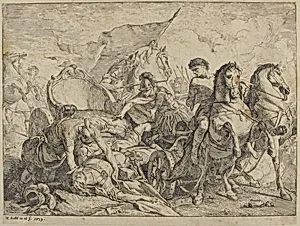
Fall of Antiochus From His Chariot
1739
Medium
Etching
Dimensions
sheet: 7 3/16 x 9 5/8 in. (18.2 x 24.4 cm)
Classification
Prints
Department
Drawings and Prints
Museum
Metropolitan Museum of Art, New York, NY
Credit
Rogers Fund, 1962
Accession Number
62.602.903
Rights
Public Domain
Tags
Art Historical Context
Welcome to the Metropolitan Museum of Art's Drawings and Prints collection, where Noël Hallé's *Fall of Antiochus From Hisariot* (1739) captures a dramatic moment of downfall. This etching, measuring just 7 3/16 x 9 5/8 inches, depicts the biblical tyrant Antiochus IV Epipes tumbling from his chariot amid soldiers, men, and rearing horses—a chaotic scene of hubris punished. French artist Noël Hallé, aoco master trained under François Boucher, excelled in history subjects, infusing them with dynamic energy and theatrical flair typical of 18th-century French art. The subject draws from 2 Maccabees 9 in the Bible, where Antiochus, the Seleucid king who desecrated the Jewish Temple, meets divine retribution during his campaign. As he rides in triumph, he suddenly collapses from his chariot, struck by affliction—a vivid moral tale of pride's peril that resonated in Baroque and Rococo eras, blending ancient history with Christian allegory. Hallé's etching technique shines here: by biting acid into a copper plate, he achieved intricate lines conveying motion and emotion in this intimate format. Printed during the Enlightenment, it reflects printmaking's rise as an accessible medium for grand narratives, inviting collectors to ponder power's fragility. A Rogers Fund acquisition since 1962, this work exemplifies Rococo's elegant drama.