
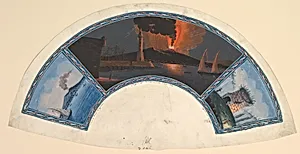
Fan Design with Eruption of Vesuvius and the Tomb of Virgil
Medium
Watercolor and gouache on vellum ?
Classification
Drawings
Department
Drawings and Prints
Museum
Metropolitan Museum of Art, New York, NY
Credit
Harris Brisbane Dick Fund, 1938
Accession Number
38.91.104
Rights
Public Domain
Tags
Art Historical Context
This delicate fan design, created by an anonymous Bolognese artist in the 18th century, captures the dramatic Eruption of Vesuvius the ancient Tomb of Virgil. Rendered in watercolor and gouache on v—a fine parchment prized for its smooth surface and luminosity—the artwork exemplifies the intricate preparatory drawings used for luxury fans, popular accessories among Europe's elite during the Rococo era. Bologna, a hub of artistic innovation, was renowned for such refined draftsmanship, blending whimsy with historical reverence. The composition evokes the Grand Tour fascination with Italy's volcanic landscapes and classical ruins. Mount Vesuvius, infamous for its 79 AD eruption that buried Pompeii and Herculaneum, symbolized nature's sublime power, while Virgil's tomb near Naples honored the Roman poet whose *Aeneid* inspired generations. Boats dot the scene, hinting at travelers approaching these wonders by sea, a nod to 18th-century tourism. As a drawing from the Metropolitan Museum of Art's Drawings and Prints collection (Harris Brisbane Dick Fund, 1938), it highlights fans as miniature canvases for storytelling—portable art that fluttered with fashion and folklore, bridging antiquity with Enlightenment curiosity.