
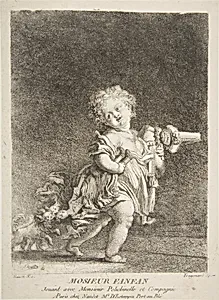
Fanfan
Medium
Etching, third state of three
Dimensions
sheet: 10 1/8 x 7 3/8 in. (25.7 x 18.8 cm) image: 9 3/4 x 6 13/16 in. (24.7 x 17.3 cm)
Classification
Prints
Department
Drawings and Prints
Museum
Metropolitan Museum of Art, New York, NY
Credit
Purchase, Roland L. Redmond Gift, Louis V. Bell and Rogers Funds, 1972
Accession Number
1972.539.1
Rights
Public Domain
Tags
Art Historical Context
Jean Honoré Fragonard, a master of French Rococo art, captures whimsy and tenderness in *Fanfan* (1778), an etching depicting children with dolls and dogs. Created during the late Rococo period, when ornate playfulness began yielding to Neoclassicism, the work embodies Fragonard's signature style: light-hearted, intimate scenes brimming with movement and joy. The title likely refers to a beloved child or pet, evoking the era's fascination with domestic innocence amid aristocratic leisure. This print is a third-state etching—the final iteration of three—measuring about 10 x 7 inches on the sheet. Etching allowed Fragonard to translate his fluid drawing style into precise, tonal lines etched into a metal plate with acid, then inked and printed. As one of his rarer graphic works, it showcases his virtuosity in printmaking, blending delicate hatching for texture with spontaneous energy, much like his famous paintings such as *The Swing*. Housed in the Metropolitan Museum of Art's Drawings and Prints department, *Fanfan* highlights 18th-century French artistry's charm, offering visitors a glimpse into Fragonard's world of fleeting pleasures and familial warmth. Its acquisition in 1972 underscores its enduring appeal as a gem of Rococo print culture.
About the Artist
Jean Honoré Fragonard · 1732–1806
Jean-Honoré Fragonard (1732-1806) was a French painter and printmaker whose late Rococo manner was distinguished by remarkable facility, exuberance, and hedonism. Born in Grasse, he moved to Paris where he trained under Jean-Baptiste Chardin and François Boucher, winning the prestigious Prix de Rome in 1752. After studying in Italy alongside Hubert Robert, Fragonard returned to Paris in 1761 to fi...