
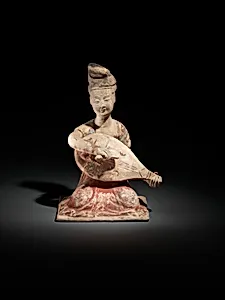
唐 彩繪陶持琵琶樂伎女俑|Female musician with lute
Unknown Artist
late 7th century
Medium
Earthenware with pigment
Dimensions
H. 5 3/4 in. (14.6 cm); W. 3 1/2 in. (8.9 cm); D. 3 1/8 in. (7.9 cm)
Classification
Tomb Pottery
Culture & Period
China · Tang dynasty (618–907)
Department
Asian Art
Museum
Metropolitan Museum of Art, New York, NY
Credit
Rogers Fund, 1923
Accession Number
23.180.4
Rights
Public Domain
Tags
Art Historical Context
This charming earthenware figure of a female musician holding a pipa (a pear-shaped lute) captures the vibrancy of Tang dynasty life in late 7th-century China. Standing just under 6 inches tall, this tomb pottery, or *mingqi*, was crafted to accompany the deceased into the afterlife, providing entertainment in the spirit world. Discovered and acquired by the Metropolitan Museum of in 1923 through the Rogers Fund, it the Tang era's (618–907) prosperity and cosmopolitan flair, when China was a cultural crossroads influenced by Central Asian trade along the Silk Road. The Tang dynasty revered music and performance, with female musicians like this one—depicted in flowing robes and poised to play—holding esteemed roles in imperial courts and elite households. Her detailed pigmentation, applied over fired clay, brings to life her serene expression, elaborate hairstyle, and the intricate strings of her pipa, a beloved instrument that symbolized refinement and harmony. These small-scale figures reflect the era's artistic realism and technical skill in low-fired earthenware, where vivid reds, greens, and blacks have endured centuries. Today, this piece offers a window into Tang society's celebration of artistry and femininity, reminding us how everyday joys were immortalized for eternity.