
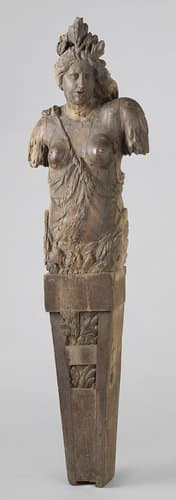
Female Terminal Figure (Flora ?)
ca. 1700 - ca. 1725
Medium
oak
Dimensions
197
Rights
Public Domain
About this artwork
hoogte 197 cm
Art Historical Context
This imposing oak sculpture, standing nearly two meters tall, represents a female terminal figure—likely intended as Flora, the Roman goddess of flowers and spring. Created anonymously between 1700 and 1725, the work belongs to a long tradition of garden and architectural statuary that revived classical forms during the late Baroque period. Terminal figures, derived from ancient Roman herms, served as decorative boundaries or accents in formal landscapes, blending human form with architectural function. Carved from durable oak, the figure would have withstood outdoor exposure while displaying the rich grain and warm tones characteristic of Northern European wood sculpture. Its substantial height suggests it was designed to be viewed from below, perhaps lining a garden path or framing an entrance. Though the artist remains unknown, the piece reflects the era’s fascination with mythological themes and the desire to evoke an idealized classical past in aristocratic estates and public spaces. Such terminal figures were both practical markers and symbols of abundance, reminding viewers of nature’s cycles and the harmony between art and the natural world. Today, this work offers a glimpse into early eighteenth-century garden design and the enduring appeal of mythological imagery in European decorative arts.
About the Artist
anonymous
In the vast tapestry of art history, "Anonymous" stands not as a singular individual but as a collective designation for countless unidentified creators whose works have endured across millennia. These artists, spanning prehistoric cave painters to medieval illuminators and folk craftsmen, produced the foundational layers of human visual culture. Prior to the Renaissance, when individual fame emer...