
Fencing Book (Fechtbuch)
16th century copy of a mid-15th century manuscript
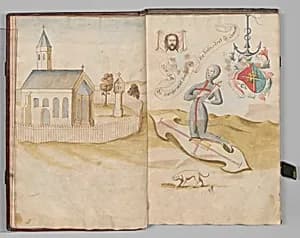
Medium
Leather, brass
Dimensions
H. 12 7/8 in. (32.7 cm); W. 8 1/8 in. (20.6 cm)
Classification
Books & Manuscripts
Culture
German
Department
Arms and Armor
Museum
Metropolitan Museum of Art, New York, NY
Credit
Gift of Miss Marguerite Keasbey, 1926
Accession Number
26.236
Rights
Public Domain
Tags
About this artwork
This manuscript is a 16th-century copy of Hans Talhoffer's influential Fechtbuch, or fencing book, originally created in the mid-15th century. The volume provides illustrated instructions for various methods of fighting, both with and without armor, on foot and on horseback, including the specialized weapons employed in judicial combat. The manuscript includes sections devoted to procedures for trial by combat and the use of weapons such as Stechschilde (thrusting shields), maces, long swords, s...
Art Historical Context
Step into the world of medieval combat with Hans Talhoffer's *Fencing Book (Fechtbuch)*, a 16th-century copy of his mid-15th-century masterpiece preserved at the Metropolitan Museum of Art. Crafted in ink on vellum or paper with a sturdy leather and brass binding, this compact volume (measuring just 12⅞ by 8⅛ inches) bursts with vivid illustrations of fencing techniques. Talhoffer, a renowned German fencing master active from around 1410 to after 1482, produced at least five such manuals while training warriors for life's ultimate stakes—trial by combat. The book offers practical, illustrated guidance on armed and unarmed fighting, both on foot and horseback, with and without armor. It spotlights specialized judicial weapons like thrusting shields (*Stechschilde*), maces, longswords, spears, and daggers, even detailing trial procedures. Drawing from the teachings of grand master Johannes Liechtenauer, Talhoffer's influential 1467 original—commissioned by Count Eberhardt I von Württemberg—shaped German martial traditions. As one of Europe's earliest surviving fencing manuals, this copy underscores the enduring legacy of Talhoffer's work, blending art and instruction to document a fierce era of chivalric violence. A gift to the Met in 1926, it invites us to appreciate how these pages preserved life-saving skills for generations.