
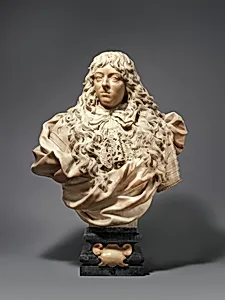
Ferdinando de' Medici, Grand Prince of Tuscany
ca. 1680–82
Medium
Marble, gray marble
Dimensions
Overall (confirmed): 38 3/4 × 28 7/8 × 14 in., 337 lb. (98.4 × 73.3 × 35.6 cm, 152.9 kg)
Classification
Sculpture
Culture
Italian, Florence
Department
European Sculpture and Decorative Arts
Museum
Metropolitan Museum of Art, New York, NY
Credit
Purchase, The Annenberg Foundation Gift, 1993
Accession Number
1993.332.2
Rights
Public Domain
Tags
Art Historical Context
Behold the commanding marble bust of *Ferdinando de', Grand Prince of Tuscany crafted by the Florentine Baroque master Giovanni Battista Foggini 1680–82. Carved from both white and gray marble, this life-sized portrait (nearly 39 inches tall and weighing over 300 pounds) captures the young heir's noble poise and introspective gaze, with intricate detailing in his draped attire and flowing hair that exemplifies Foggini's virtuosic sculptural technique. Ferdinando (1663–1713), eldest son of Grand Duke Cosimo III de' Medici, embodied the enduring legacy of Florence's ruling dynasty, famed for Renaissance patronage but thriving into the Baroque era. Foggini, a key court artist, specialized in such grand portraits that blended classical idealism with dramatic realism, using contrasting marbles to heighten depth and texture—gray for shadows, white for highlights. This bust likely served as a symbol of Medici prestige in palatial settings. Acquired by The Metropolitan Museum of Art in 1993 through The Annenberg Foundation, it stands as a testament to 17th-century Italian sculpture's opulence, inviting visitors to ponder the fleeting glory of princely ambition amid Tuscany's artistic golden age.
About the Artist
Giovanni Battista Foggini · 1652–1725
**Giovanni Battista Foggini** (1652–1725) was a leading Italian sculptor and architect of the late Baroque period, born in Florence within the Grand Duchy of Tuscany. He began his career under the patronage of the Medici family, who sponsored his artistic training. In 1673, at the age of 21, Cosimo III de' Medici sent the young Foggini to Rome to join the newly founded Accademia Fiorentina, where ...