
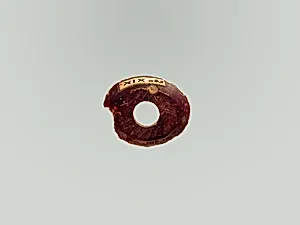
Fibula, fragment
Unknown Artist
7th–6th century BCE
Medium
Amber
Dimensions
Other: 1/4 x 3/4 x 15/16 in. (0.7 x 1.9 x 2.4 cm)
Classification
Miscellaneous-Amber
Culture & Period
Etruscan · Archaic
Department
Greek and Roman Art
Museum
Metropolitan Museum of Art, New York, NY
Credit
Purchase, 1896
Accession Number
96.9.495
Rights
Public Domain
Art Historical Context
This delicate fragment of an Etruscan fibula dating to the 7–6th century BCE offers a glimpse into the Archaic period of one of ancient Italy's most enigmatic cultures. The Etruscans, in central Italy before the rise of Rome, were renowned for their sophisticated metalwork and jewelry, often blending local traditions with influences from Greece and the eastern Mediterranean. Fibulae like this served as practical brooches to fasten clothing, but they were also status symbols, adorning the elite with intricate designs. Crafted from amber—a rare, golden resin sourced from Baltic Sea shores and traded across vast networks—this tiny piece (just 1/4 x 3/4 x 15/16 in.) highlights the Etruscans' access to luxury materials. Amber's warm translucency made it prized for personal ornaments, symbolizing wealth and vitality in a pre-industrial age. Though only a fragment survives, it evokes the precision of Etruscan artisans who carved and polished such gems by hand. Acquired by The Metropolitan Museum of Art in 1896, this artifact from the Greek and Roman Art department underscores the enduring allure of Etruscan craftsmanship, bridging everyday life and high artistry in the ancient world.