
Fifty-three Stations on the Tokaido Road (Tōkaidō gojūsan tsugi) 東海道五十三次
Medium
Ink on paper
Dimensions
4 1/2 × 6 1/2 × 2 3/8 in. (11.4 × 16.5 × 6 cm)
Classification
Illustrated Books
Culture & Period
Japan · Edo period (1615–1868)
Department
Asian Art
Museum
Metropolitan Museum of Art, New York, NY
Credit
Rogers Fund, 1918
Accession Number
JIB52
Rights
Public Domain
Tags
Art Historical Context
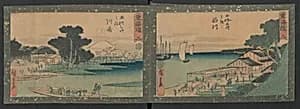
This charming illustrated book by Utagawa Hiroshige captures the spirit of travel along Japan’s historic Tōkaidō highway during the Edo period. Hiroshige, celebrated for his sensitive depictions of landscapes and everyday life, presents the fifty-three stations that dotted the route between Edo and Kyoto. Through delicate ink drawings on paper, the pages evoke the changing scenery—mountain passes, coastal views, and bustling post towns—inviting viewers to imagine the journey undertaken by merchants, pilgrims, and officials. Created in the early nineteenth century, the work reflects the growing popularity of travel literature and ukiyo-e imagery among a widening audience. Hiroshige’s economical yet evocative line work brings to life the tags’ elements: modest houses, figures on the road, towering mountains, leafy trees, and boats along waterways. As an illustrated book rather than a single print, it offered portable enjoyment, allowing readers to follow the route page by page much like a modern travel journal. Housed in the Metropolitan Museum of Art’s Asian Art collection, this compact volume (roughly the size of a small handbook) preserves both artistic skill and cultural memory of a transformative era in Japanese history.
About the Artist
Utagawa Hiroshige · 1826–1869
Utagawa Hiroshige (1797–1858), born Andō Tokutarō, was the last great master of Japanese ukiyo-e woodblock printmaking and one of the most influential landscape artists in history. Born in Edo (modern Tokyo) into a low-ranking samurai family serving as fire wardens, Hiroshige transformed landscape printmaking into a poetic meditation on nature, weather, and everyday life. His revolutionary approac...