
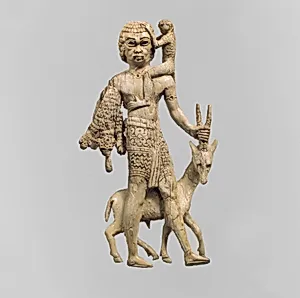
Figure of a man with an oryx, a monkey, and a leopard skin
Unknown Artist
ca. 8th century BCE
Medium
Ivory
Dimensions
H. 5 5/16 x W. 3in. (13.5 x 7.6cm)
Classification
Ivory/Bone-Sculpture
Culture & Period
Assyrian · Neo-Assyrian
Department
Ancient Near Eastern Art
Museum
Metropolitan Museum of Art, New York, NY
Credit
Rogers Fund, 1960
Accession Number
60.145.11
Rights
Public Domain
Tags
Art Historical Context
This exquisite ivory sculpture, titled *Figure of a Man with an Oryx, a Monkey, and a Leopard*, hails from the Neo-Assrian period around the 8th century BCE. Carved by an unknown Assyrian artist, it stands just 5 5/16 inches tall, a testament the remarkable skill of ancient Near Eastern craftsmen working in miniature. Housed the Metropolitan Museum of Art Department of Ancient Near Eastern, this piece captures a bearded man holding an oryx (a graceful antelope) and a monkey, draped in a leopard skin—symbols of exotic luxury and power drawn from distant lands. In the Neo-Assyrian Empire, at its height under kings like Ashurnasirpal II and Sargon II, such ivories adorned opulent palace furniture, thrones, and beds unearthed at sites like Nimrud and Khorsabad. Elephant ivory, a prized import, was meticulously carved to depict attendants, hunts, or mythical scenes, reflecting the empire's vast conquests and control over trade routes from Africa and India. The lively poses of the animals and the man's authoritative stance evoke the Assyrian fascination with nature's wild beauty tamed by human dominion. Artistically, the sculpture's shallow relief and fluid lines showcase advanced techniques in incising details like fur, feathers, and musculature on a delicate medium prone to cracking. For visitors, it offers a window into a world of imperial grandeur, where everyday luxury items doubled as propaganda celebrating Assyrian might. (218 words)